
Noise Control for Superior Medical & Endoscopy Imaging
In medical imaging, every detail matters. Noise-artifacts that do not originate from the actual scene, can obscure critical structures and reduce diagnostic confidence. Especially in endoscopy and medical cameras , often operating under low-light conditions, controlling noise is essential for achieving reliable image quality. Key Insights & Challenges Noise is caused by statistical signal fluctuations and appears as a grainy structure across the image. The most relevant types include: Temporal Noise (Random Noise): Caused by variations in photon-to-electron conversion (photon shot noise), particularly dominant in low-light scenarios. Spatial Noise (Fixed Pattern / Non-Uniformity): Pixel-level inconsistencies such as PRNU* and DSNU**, leading to visible non-uniformities. In endoscopic environments, limited light reduces the signal level, making a strong Signal-to-Noise Ratio (SNR) harder to achieve. Additionally, color sensors may introduce color noise due to demosaicing, further impacting image clarity.
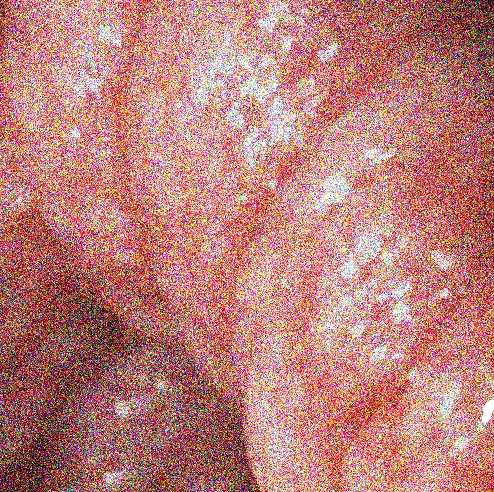
In medical imaging, every detail matters. Noise-artifacts that do not originate from the actual scene, can obscure critical structures and reduce diagnostic confidence. Especially in medical and endoscopy cameras, often operating under low-light conditions, controlling noise is essential for achieving reliable image quality.
Key Insights & Challenges
Noise is caused by statistical signal fluctuations and appears as a grainy structure across the image. The most relevant types include:
Temporal Noise (Random Noise): Caused by variations in photon-to-electron conversion (photon shot noise), particularly dominant in low-light scenarios.
Spatial Noise (Fixed Pattern / Non-Uniformity): Pixel-level inconsistencies such as PRNU* and DSNU**, leading to visible non-uniformities.
In endoscopic environments, limited light reduces the signal level, making a strong Signal-to-Noise Ratio (SNR) harder to achieve. Additionally, color sensors may introduce color noise due to demosaicing, further impacting image clarity.