Versatile Light System

    A dynamic solution for CTA, CSNR, MMP, and other high-intensity measurements outlined in the IEEE-2020 standard.

    Versatile Light System (VLS)

    Versatile Light System (VLS)

    Product Overview

    The VLS (Versatile Light System) is a versatile illumination solution that efficiently measures a wide range of image quality factors, including contrast transfer accuracy (CTA), modulated light mitigation probability (MMP), and contrast signal-to-noise ratio (CSNR). The setup, powered by six Vega light sources, creates a dynamic scene that can be quickly rearranged to simulate typical illumination challenges for automotive cameras and sensor systems.

    Vega light source

    The Vega light source uses DC technology to deliver a high-stability output with flicker-generation capabilities. DC technology benefits all camera testing, including tests with very short exposure times, such as automotive-grade cameras.

    VLS Hardware setup

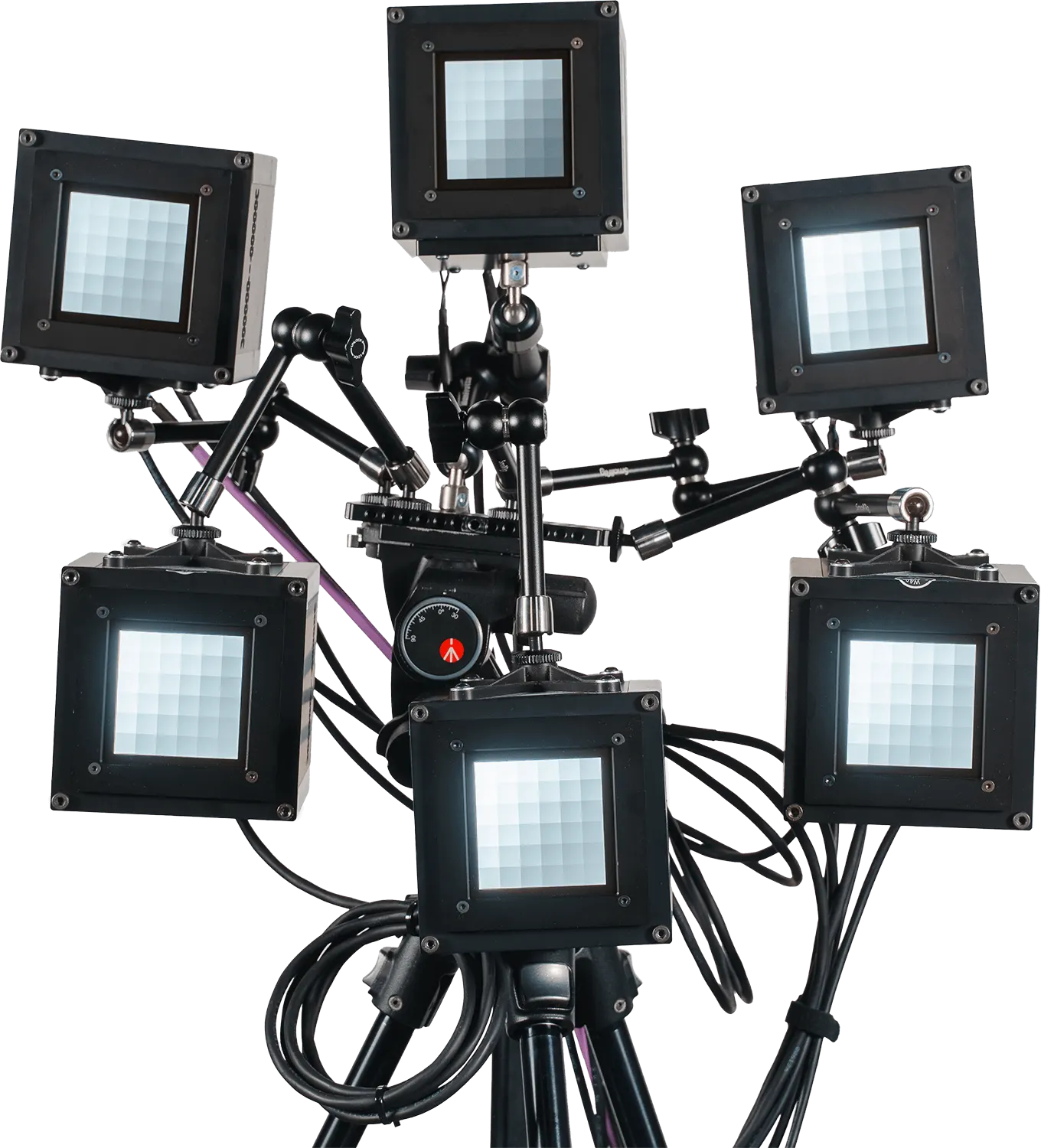
    The VLS is a system of six Vega devices, each connected to an individual arm*. All Vegas are linked via the arms to a tripod, offering high adaptability. The arms' flexibility allows each Vega to be moved to generate a range of configurations and angles during testing, providing versatile testing capabilities.

    We offer a product package that includes Vega light sources (up to six) and the flexible mounting option for creating dynamic test scenes. The cost varies depending on the number of light sources and mounting options. Contact our sales team for pricing details.

    This product is not automated; each arm of the VLS must be manually moved and set. However, during the product development, a manual setup proved faster and more efficient than full automation.

    Test Charts

    Additionally, we offer grayscale test charts designed for use with Vega devices. The chart is a transmissive gray step chart with 36 patches and a 10:1 contrast. It magnetically attaches to the front of the Vega light source, thereby ensuring uniform illumination. Charts are sold separately.

    *The mounting system is sold separately. We use third-party products to enable our customers to create flexible setups. The arm and tripod are third-party products, and the setup shown is an example of how the user can set up the light sources using them.

    Key Benefits of the VLS

    IEEE-2020 measurements

    Measure most of the KPIs from the IEEE-2020 standard, including CTA, CSNR, MMP, and dynamic range.

    Fleixble test setups

    Create a dynamic test scene using individual arms to move and place light sources at different angles.

    DC-powered light sources

    VLS utilizes multiple Vegas, powered by DC technology, to generate illumination.

    Flicker testing

    The Vega light source offers advanced flicker capabilities across a wider frequency range.

    Spatial & Temporal recordings

    The VLS supports both spatial and temporal recording measurements as outlined in the IEEE-2020 standard.

    VLS Software

    The VLS has unique control and evaluation software. Vega APIs are also available.

    VLS Software

    Control and Evaluation software for the VLS.
    VLS-Control Software

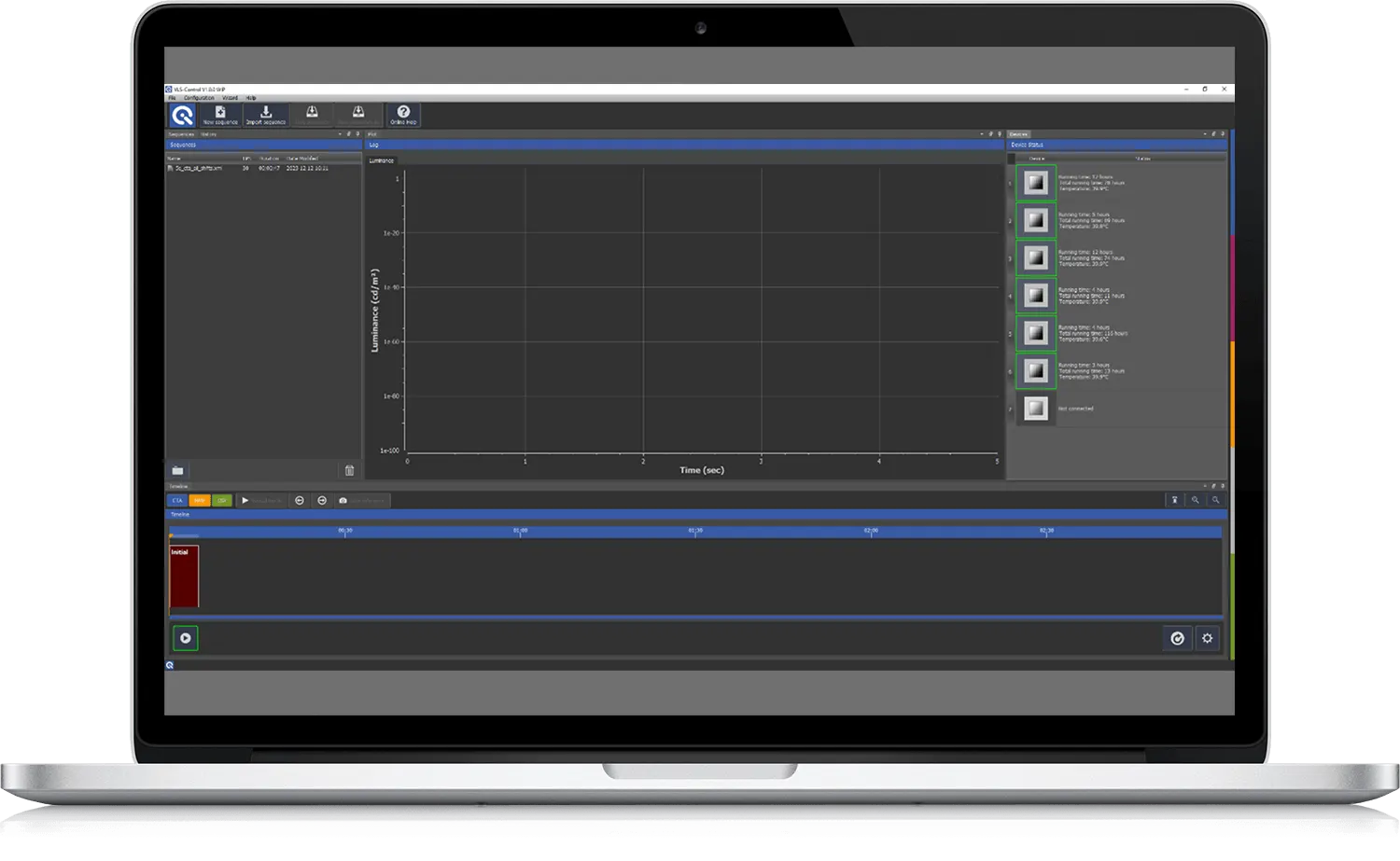
    VLS-Control

    The control software generates illumination test sequences for the Vega devices. The software can control up to six Vega devices at once. The measurement values are used to create a reference file for evaluation during testing. Sequences can be saved as XML files for future use. The VLS software is sold separately from the VLS hardware.


    VLS-Evaluation software

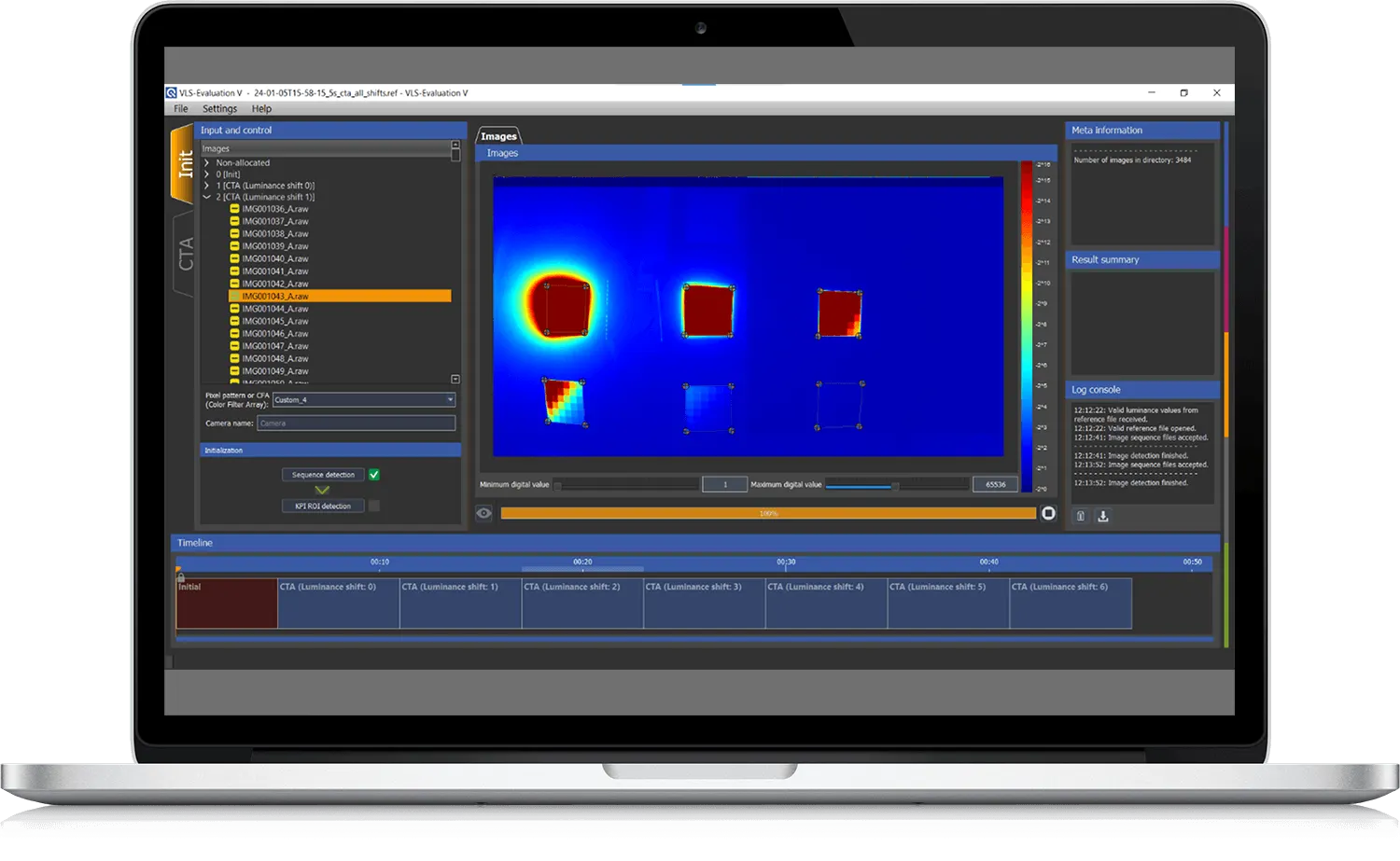
    VLS-Evaluation

    The evaluation software analyzes the camera's performance using the defined IEEE-2020 KPIs, including CTA, MMP, and CSNR. CTA evaluations are based on the pixel value distributions. Results are exported as XML files. The VLS software is sold separately from the VLS hardware.

    Use Cases

    Spatial Recordings

    Spatial recording measurements are faster and are suitable for systems that are unsuitable for temporal measurements due to lens effects or dynamic image processing (e.g., auto-exposure). The VLS now supports both spatial and temporal recording measurements, as outlined in the IEEE-2020 standard. Test results can be used to evaluate your camera system's CTA (contrast transfer accuracy), CSNR (contrast signal-to-noise ratio), and dynamic range performance.

    Temporal Recordings

    Temporal recording measurements allow you to capture one image per luminance step, avoiding flare that often occurs during camera alignment to a light source. he VLS now supports both spatial and temporal recording measurements as outlined in the IEEE-P2020 standard. Test results can be used to evaluate your camera system's CTA (contrast transfer accuracy), CSNR (contrast signal-to-noise ratio), and dynamic range performance.

    Product Video

    Technical Specifications (Vega)

    SpecificationValue
    Light Source 36 Temperature controlled LEDs based on iQ-DC technology
    Uniformity (active area)> 95% at 100% output intensity | > 94% at 10% output intensity | > 90% at 1% output intensity | > 90% at 0.1% output intensity
    Illumination stability± 0,5%
    Correlated Color Temperature (CCT)4900 K (± 200 K)
    Color Rendering Index (CRI)> 95
    Minimum luminance0.1 – 0.5 cd/m2
    Maximum luminance55,500 – 61,500 cd/m²
    Dim function Software based | 106 - 10 steps
    Flicker frequency range1 – 1000 Hz (Square) | 10 – 1000 Hz (Sine) | 10 – 1000 Hz (Triangle)
    Flicker frequency step width0.1 Hz (1 – 200 Hz) | 0.2 Hz (200 – 500 Hz) | 0.5 Hz (500 – 1000 Hz)

    Software Downloads

    Download the latest software package for Vega.

    Vega Software (Version 1.0.0)

    Vega software (Windows 64bit installer)

    Vega APIs

    Contact our sales teams for API access

    VLS-Evaluation

    Contact our sales team for download access

    Documentation

    Vega Datasheet (EN)

    Technical specifications and product details

    Vega Datenblatt (DE)

    Technische Spezifikationen und Produktdetails

    VLS User Manual (EN)

    Complete operating instructions

    Vega Betriebsanleitung (DE)

    Vollständige Betriebsanleitung

    VLS Product Flyer

    A basic product overview

    Vega C API documentation (web)

    Vega C++ API documentation (web)

    Vega Python API documentation (web)