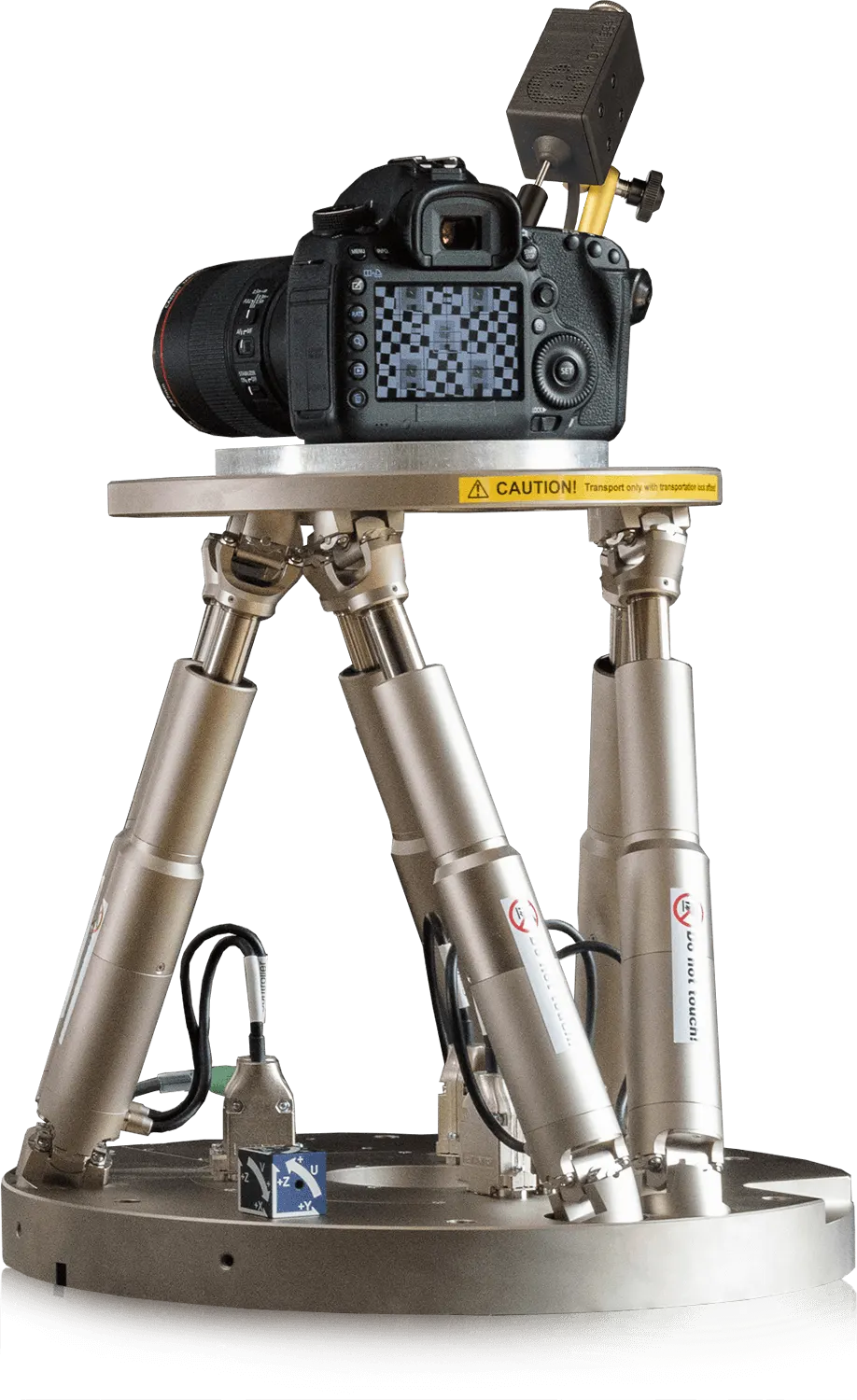
STEVE-6D: Camera Stabilization Measurement Device - The Stabilization Evaluation Equipment (STEVE) has been developed to analyze the optical image stabilizers (OIS) of a camera system. These stabilizers provide better image quality by compensating for the human hand’s natural tremor. If stabilization is working well, it can prevent image blur. To begin a measurement with STEVE, a digital camera or mobile phone must first be mounted securely on the hardware. The software solution allows users to define arbitrary six-degree-of-freedom motion, thereby controlling STEVE-6D's vibration. The software also controls iQ-Trigger, a remote-controlled, mechanical “finger " that presses the camera’s shutter button. The software’s analysis module evaluates the resulting images. The results provide insight into the image stabilizer’s performance. Six degrees of freedom The previous model, STEVE-2D, had two degrees of freedom; STEVE-6D has six. The intricate movements are performed by a hexapod. An efficient control software individually controls the frequency and amplitude of each movement direction. The software’s analysis function automatically evaluates recordings from the test chart TE261 and presents the image stabilizer’s performance numerically and graphically. STEVE can generate different vibrations: a CIPA-compliant vibration, sine waves, or individual waveforms. With STEVE, all movements can be reproduced accurately and consistently. The delivery for STEVE-6D includes the hardware (hexapod)*, the control and analysis software, the automated shutter-triggering device iQ-Trigger , and the iQ-Mobilemount . Ideally, STEVE-6D should be combined with the TE261 test chart. The iQ-Anchor is an accessory that securely attaches STEVE. Another option is to mount STEVE on the Honeycomb Breadboard , a stable board compatible with an existing table. We offer an API (iQ-Drive API) for use with a motorized mounting setup. API is sold separately. *The hexapod is a 3rd party product.
The Stabilization Evaluation Equipment (STEVE) has been developed to analyze the optical image stabilizers (OIS) of a camera system. These stabilizers provide better image quality by compensating for the human hand’s natural tremor. If stabilization is working well, it can prevent image blur.
To begin a measurement with STEVE, a digital camera or mobile phone must first be mounted securely on the hardware. The software solution allows users to define arbitrary six-degree-of-freedom motion, thereby controlling STEVE-6D's vibration. The software also controls iQ-Trigger, a remote-controlled, mechanical “finger " that presses the camera’s shutter button. The software’s analysis module evaluates the resulting images. The results provide insight into the image stabilizer’s performance.
Six degrees of freedom
The previous model, STEVE-2D, had two degrees of freedom; STEVE-6D has six. The intricate movements are performed by a hexapod. An efficient control software individually controls the frequency and amplitude of each movement direction. The software’s analysis function automatically evaluates recordings from the test chart TE261 and presents the image stabilizer’s performance numerically and graphically.
STEVE can generate different vibrations: a CIPA-compliant vibration, sine waves, or individual waveforms. With STEVE, all movements can be reproduced accurately and consistently.
The delivery for STEVE-6D includes the hardware (hexapod)*, the control and analysis software, the automated shutter-triggering device iQ-Trigger, and the iQ-Mobilemount. Ideally, STEVE-6D should be combined with the TE261 test chart. The iQ-Anchor is an accessory that securely attaches STEVE. Another option is to mount STEVE on the Honeycomb Breadboard, a stable board compatible with an existing table.
We offer an API (iQ-Drive API) for use with a motorized mounting setup. API is sold separately.
*The hexapod is a 3rd party product.