Shutter speed measurement via LED-Panel
A practical method for measuring shutter speed accuracy by capturing and analyzing high-frequency LED pulse patterns.
Introduction
Shutter speed is one of the most fundamental camera parameters, directly influencing image brightness, motion blur, and the accuracy of image capture. While modern cameras allow users to select precise exposure times, the actual exposure duration can differ from the nominal shutter speed due to mechanical tolerances, shutter design, timing inaccuracies, or the finite opening and closing times of the shutter mechanism. These deviations can affect both photographic results and quantitative image-quality measurements.
Verifying shutter speed accuracy is therefore important in applications ranging from photography and cinematography to scientific imaging and camera characterization. By comparing the intended exposure time with the effective exposure time, it is possible to assess shutter performance and identify systematic timing errors. [
One practical approach is to use a high-frequency LED-Panel that generates precisely timed light pulses. By capturing the LED pattern and counting the illuminated segments recorded during the exposure, the camera's effective exposure time can be calculated and compared with the nominal shutter speed. This method provides a simple and reliable way to evaluate shutter accuracy across a wide range of exposure settings.
At a Glance
Purpose: Verify the accuracy of a camera's shutter speed by measuring the actual exposure time. [
Method: Capture a high-frequency LED panel with a known blinking frequency and count the illuminated LEDs recorded during exposure.
Calculation: The effective exposure time is determined from the number of visible LED pulses and the LED frequency.
Applications: Camera characterization, image quality testing, product validation, and troubleshooting exposure timing issues.
Mechanical Shutters: Opening and closing times can influence the measurement result and should be considered for accurate calculations.
Electronic Shutters: While no mechanical movement is involved, effective exposure timing can still deviate from the nominal setting and should be verified when precise timing is required.
Results: Repeated measurements allow the assessment of shutter accuracy, consistency, and exposure deviations expressed in exposure values (EV). [
Output: The measured exposure time can be directly compared with the camera's nominal shutter speed to identify timing errors.
Shutter Speed Measurement Using an LED Panel
One practical method for measuring shutter speed accuracy uses a high-frequency LED panel as a precisely timed light source. By analyzing the LED pulses captured during an exposure, the camera's effective exposure time can be calculated and compared with the nominal shutter speed. This provides a simple and reliable way to assess shutter performance and exposure timing accuracy.
Test Procedure
The principle of shutter speed measurement is straightforward. A camera is pointed at an LED panel containing multiple LEDs that flash at a precisely controlled frequency. Because the timing of each light pulse is known, the LED panel effectively acts as a visual time reference during the exposure.
When an image of the LED panel is captured, the camera records a specific number of illuminated LEDs, depending on how long the sensor is exposed to light. By counting the visible LED pulses in the image and multiplying this value by the duration of a single pulse, the camera's effective exposure time can be calculated.
For example, if the LED panel operates at a frequency of 5 kHz and an average of 11 illuminated LEDs is recorded, the resulting exposure time is approximately 2.2 ms (1/455 s). Comparing this measured value with the nominal camera setting reveals whether the shutter is exposing for the intended duration
Repeating the measurement across multiple images helps reduce the influence of random variation and provides a more reliable assessment of shutter speed accuracy and repeatability. The resulting deviation can be expressed either as a time difference or as an exposure difference in EV.
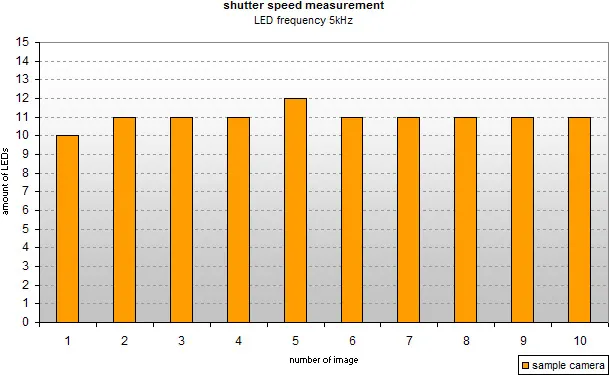
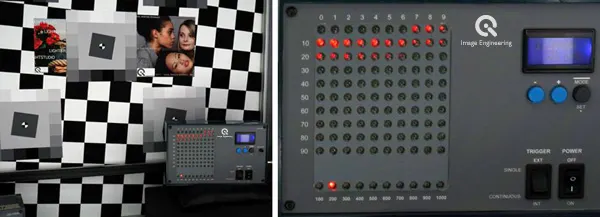
If you capture ten images with an exposure time of 1/500 s (f5.6) and count the LEDs, you may get a result shown in fig 1. The frequency of each LED is 5kHz. The average value over ten images results in 11 LEDs, which leads to an exposure time of 0.022 s.
Exposure Values
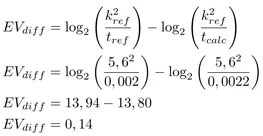
Converted in EV (exposure values) this would be a difference of +0.14 EV.
Exposure Values
In Detail Measurement
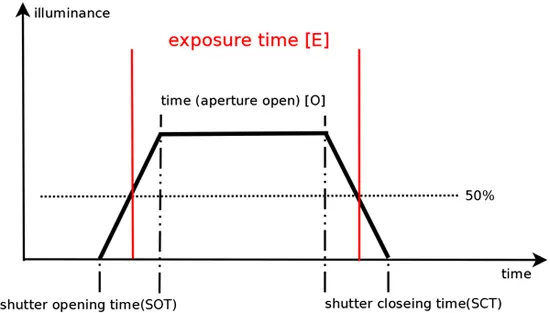
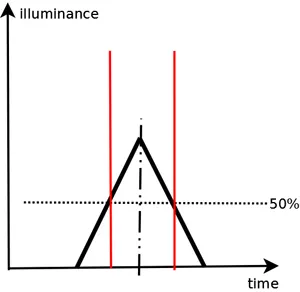
There is one thing you have to keep in mind if you measure the accuracy of shutter in this way: To be able to calculate the exact exposure time you have to know how long the shutter takes to open up. Fig 2. illustrates this problem.
Exposure Values
The rising and trailing edge of the trapezoid show the opening and closing of the aperture. Depending on the intensity of the LEDs, it is possible that they appear in the image from the beginning of the opening process to the end of the closing process, but the actual exposure time will be measured at half distance of the edges (integration of the trapezoid area). Hence follows for exact results that we need to know the time the shutter needs for opening and closing.
Leaving this aside, you will get a high measurement error by testing short exposure times.
Example
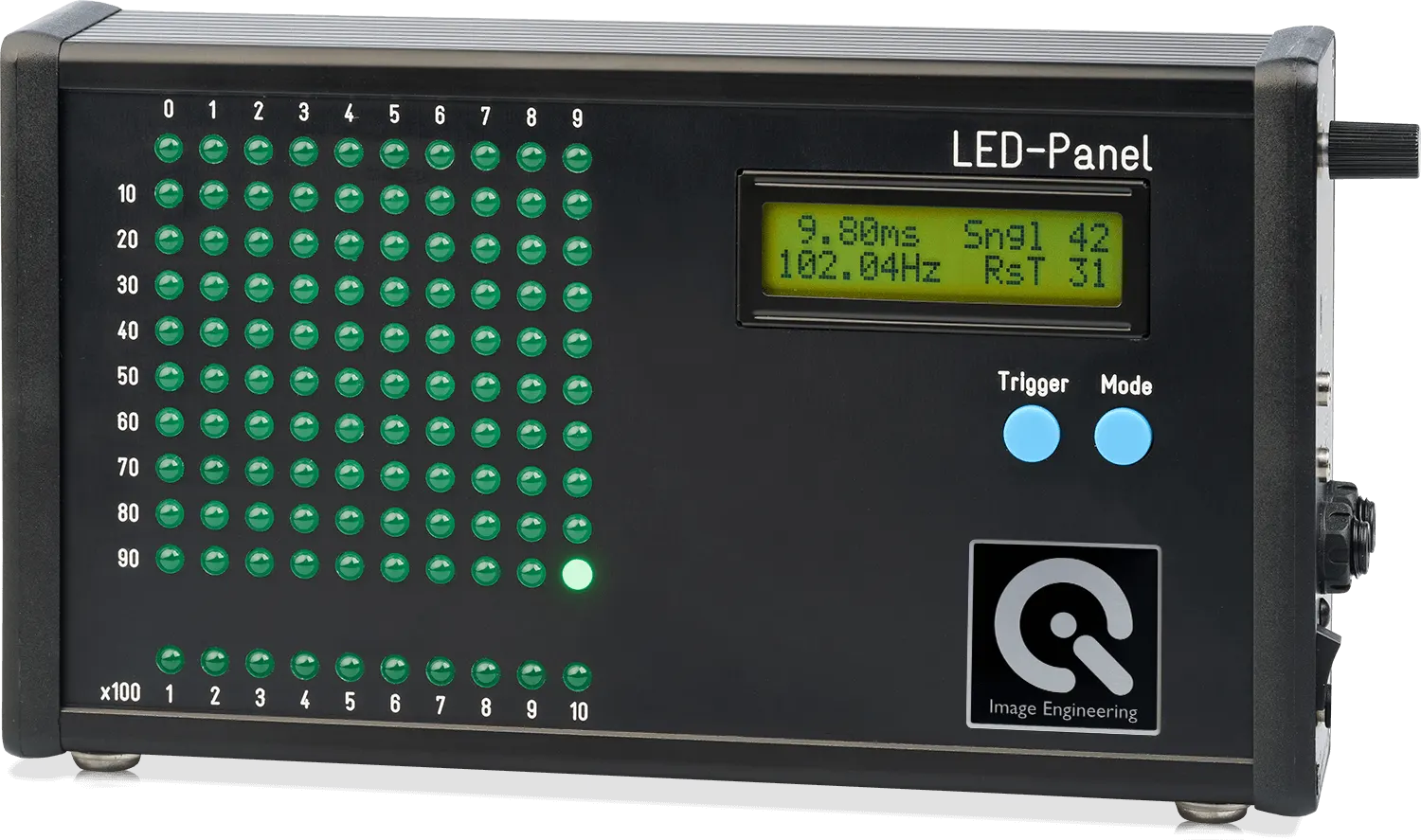
Imagine a camera with a central shutter, which needs 0.5 msec for opening/closing, then the shutter speed is 1/2000 s. With a LED frequency of 20 kHz you will obtain images as in fig. 3.
19 luminous red LEDs are counted, so the exposure time is:
The EV difference in this case is approximately +1 EV which would be very inaccurate!
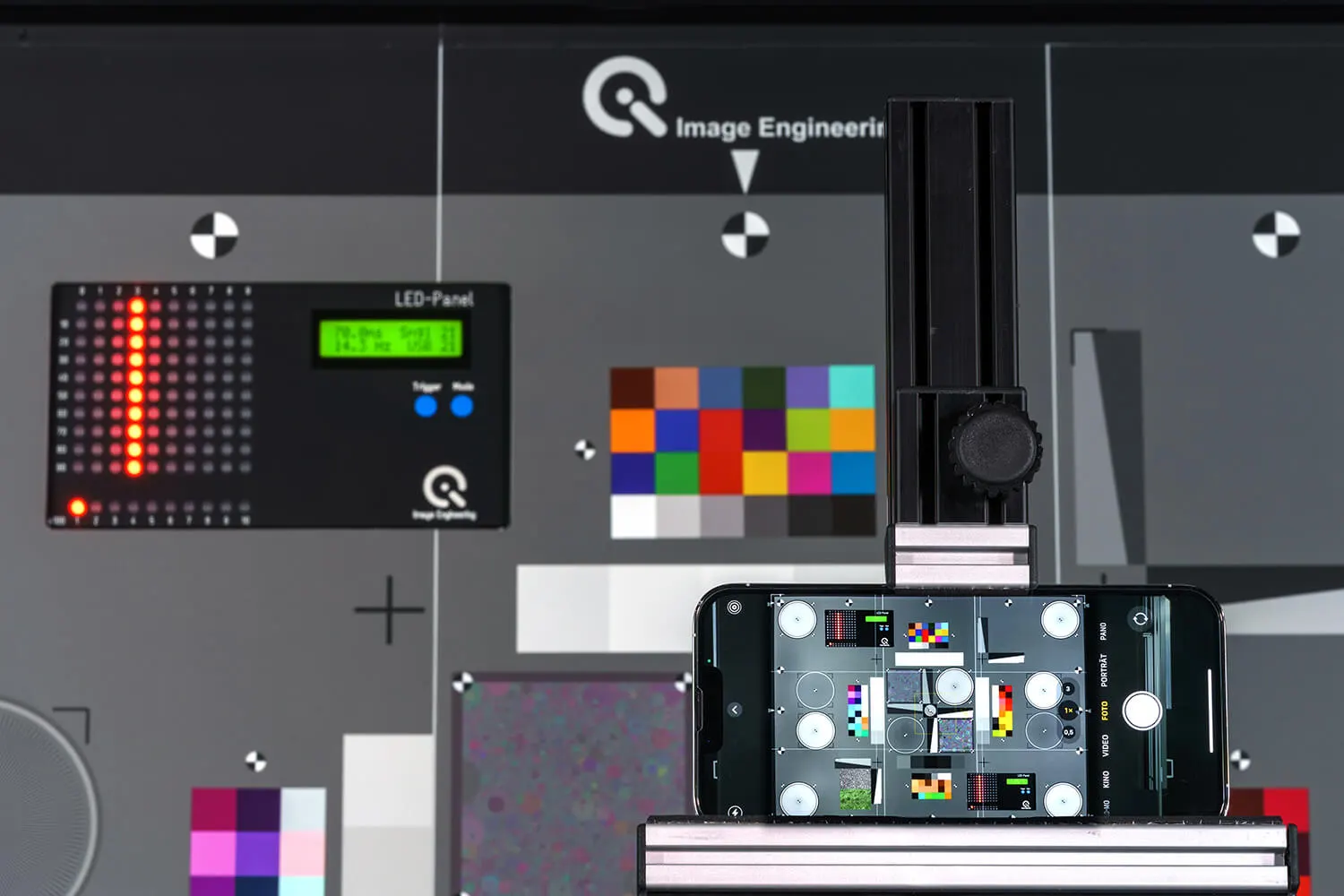
Looking at Fig. 4 and remembering the shutter opening/closing time of 0.5 msec it is evident, that we have to subtract the latter time from the calculated time and the actual exposure time can be calculated:
In EV this would be a difference of -0,15 EV.