Turn Your Camera Into a

    Turn Your Camera Into a
    Luminance Meter

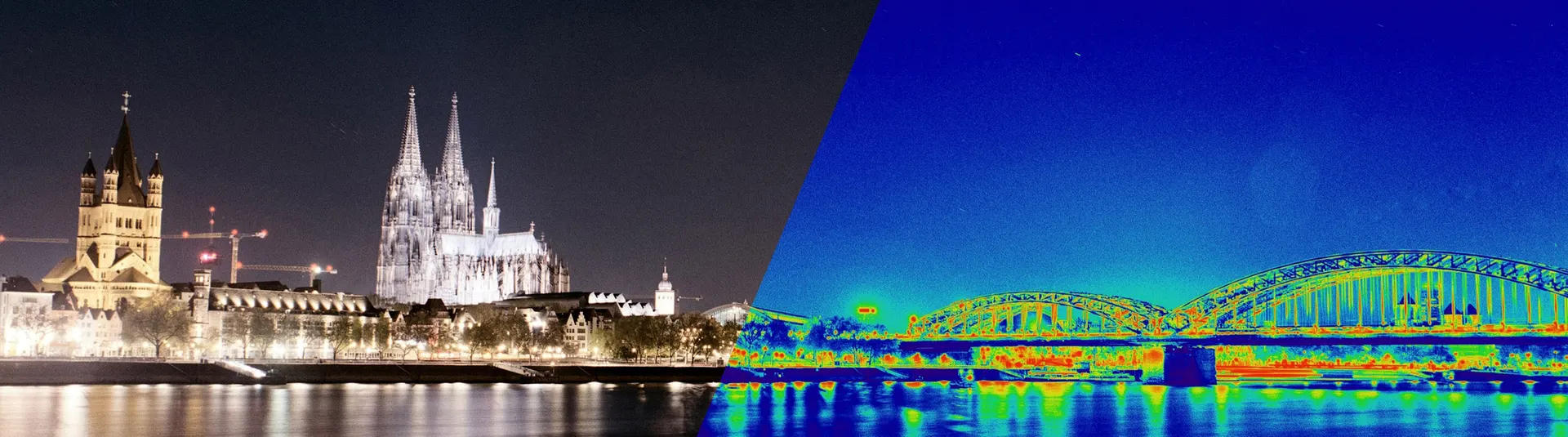
    We calibrate your digital camera so it can measure luminance, delivering spatially resolved, full-field photometric data from a single image, in the lab and in the field.

    Service Overview

    Luminance is the amount of light emitted, transmitted, or reflected from a surface in a given direction, measured in candela per square meter (cd/m²). It is the key quantity wherever visual perception, recognition, and the appearance of light matter, from display and signage evaluation to automotive, road, and general lighting applications.

    With our iQ-Luminance calibration service, we characterize your digital camera so its raw image data can be converted into absolute luminance values. The result is a photometric measurement tool that captures an entire luminance distribution in a single shot — not just a single point — combining the practicality and affordability of a consumer camera with reliable, repeatable measurements.

    Every calibration is performed under our ISO 9001-certified quality management system, using NIST-traceable reference equipment to characterize your camera — for traceable, repeatable, and fully documented results.

    Quality badges

    ISO 9001-certified QMS · NIST-traceable reference equipment

    Fine print (muted)

    This is a customized characterization service rather than an accredited ISO/IEC 17025 calibration.

    Why Use a Camera as a Luminance Meter?
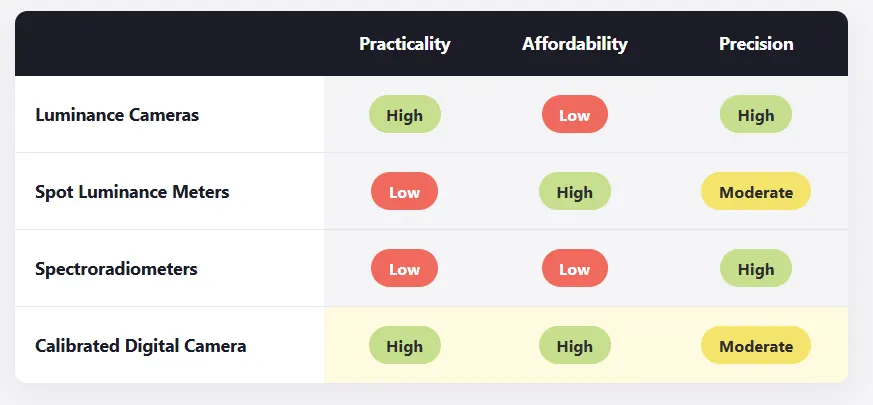
    Traditional luminance instruments force a trade-off between cost, coverage, and convenience. A calibrated digital camera offers a practical middle ground, full-field, affordable, and ready for use outside the lab.

    Compare Luminance Meters
    Compare Luminance Meters

    Calibration from the iQ-Lab

    Every camera is characterized in our Image Quality Lab using NIST-traceable reference equipment, the same lab and the same rigor we apply to objective camera testing. The calibration data has supported preliminary investigations and feasibility studies for clients who needed luminance data without investing in dedicated photometric instruments.

    Full-field measurement

    Capture an entire luminance distribution in a single image instead of point-by-point readings.

    Practical & affordable

    Use accessible camera hardware you may already own, no bulky, specialized instrument required.

    Calibrated & documented

    Each calibration is delivered with a detailed report and a ready-to-use iQ-Luminance license file.

    Where Luminance Measurement Matters
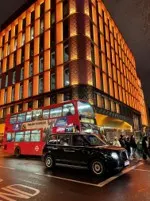
    Our customers are as diverse as the applications themselves. Wherever luminance has to be measured reliably, across a full field of view, on site, and on a budget, a calibrated camera earns its place.
    Accident Reconstruction & Expert Reports

    Accident Reconstruction & Expert Reports

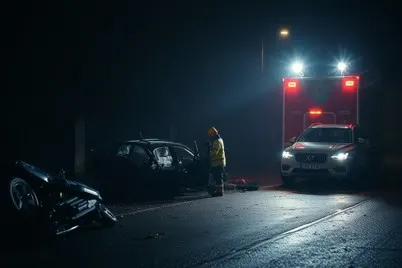
    Document and reconstruct real-world lighting conditions for forensic analysis, assessing, for example, how visible a person, obstacle, or sign was under the lighting at the scene.

    Panel Uniformity in Manufacturing

    Panel Uniformity in Manufacturing

    Measure the luminance homogeneity of illuminated panels, backlights, and displays directly in production — full-field in a single capture, for fast in-line quality control.

    Emission Planning in BIM Projects

    Emission Planning in BIM Projects

    Validate planned light emission against the as-built environment in large infrastructure and BIM projects, such as airport construction.

    Lighting Design

    Lighting Design

    Verify that lighting concepts meet their target luminance distributions for roads, architecture, signage, and public spaces.

    The Calibration Process

    The Calibration Process

    Spectral Sensitivity

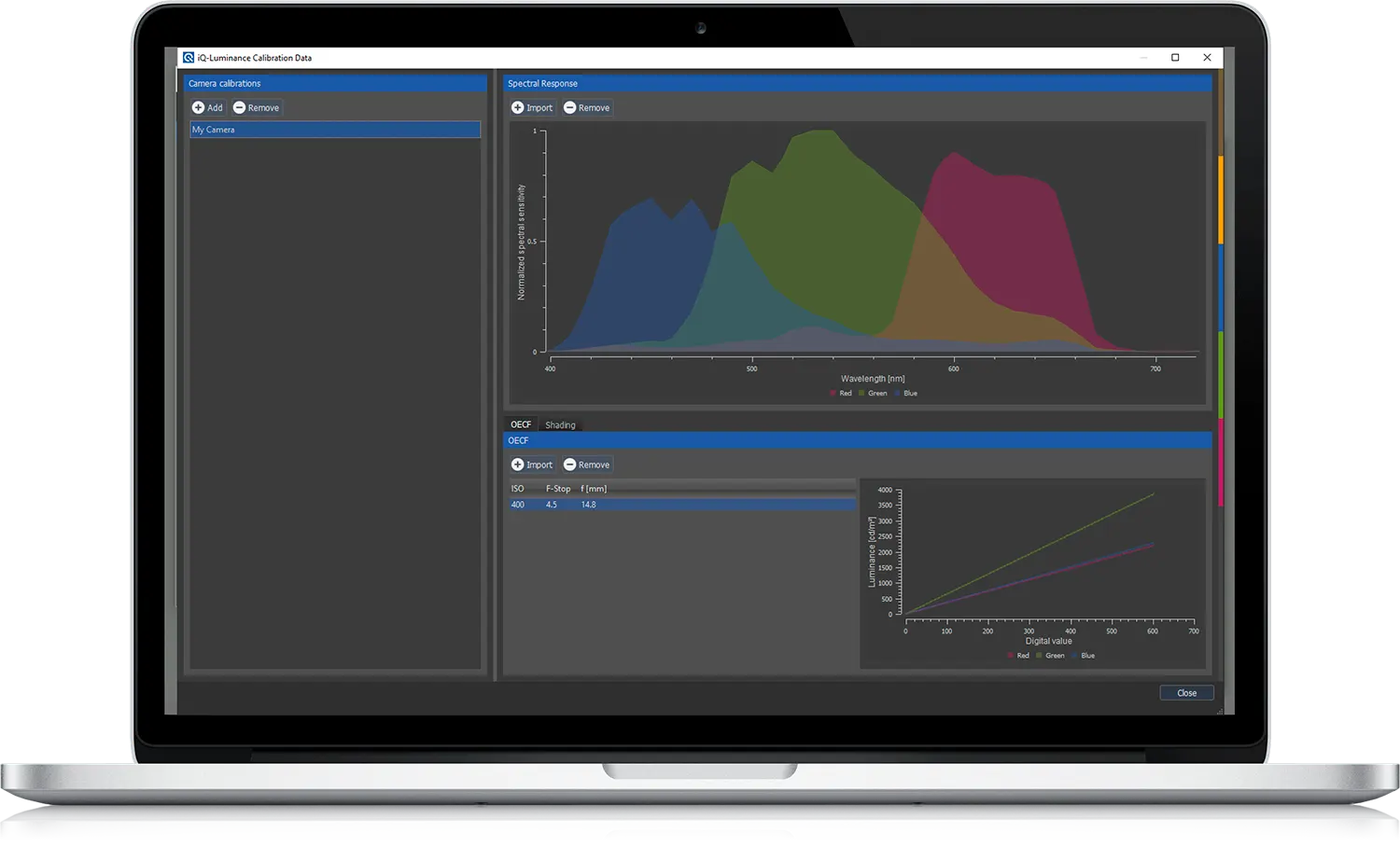
    We measure how your camera's channels respond across the visible spectrum, the basis for relating its response to the luminous weighting of the human eye.

    OECF

    We characterize the opto-electronic conversion function — the relationship between scene luminance and digital output — at multiple aperture and ISO settings.

    based on ISO 14524

    Lens Shading

    We measure the edge light fall-off (vignetting) so luminance can be read accurately across the full frame, not only in the center.

    based on ISO 17957

    Validation

    We verify the calibrated system against reference luminances to confirm measurement accuracy before delivery.

    Is Your Camera Compatible?

    To be calibrated, your camera needs to support a few essential features.

    ✓Manual control 

    of aperture, exposure time, and ISO speed.

    ✓RAW output 

    in a common format (DNG, CR3, NEF, etc.).

    ✓EXIF data 

    storing the aperture, exposure time, and ISO values. This is usually only an issue with fully manual lenses that do not communicate the set aperture value electronically.

    We have also successfully calibrated camera drones in the past — if you are unsure whether your system qualifies, just ask.

    Packages & Deliverables

    Two calibration packages, tailored to prime and zoom lenses. The customer supplies the test samples and is responsible for their condition and operation.
    PRIME €1990 net

    Customized calibration of one camera and one focal length on a prime or zoom lens.

    Up to 6 × OECF (based on ISO 14524)

    1 × spectral sensitivity measurement

    1 × color rendering measurement

    1 × edge light fall-off (based on ISO 17957)

    Calibration report

    iQ-Luminance download

    By default, calibration uses the system's native ISO, starting at the open aperture and doubling each step, for a total of 6 apertures.

    ZOOM €2990 net

    Customized calibration of one camera and two focal lengths on a zoom lens (shortest and longest).

    Up to 12 × OECF (based on ISO 14524)

    1 × spectral sensitivity measurement

    1 × color rendering measurement

    2 × edge light fall-off (based on ISO 17957)

    Calibration report

    iQ-Luminance download

    By default, 6 apertures are calibrated per focal length at the system's native ISO. All prices are net, excluding VAT and shipping.

    Included Software

    Your calibration files are designed to work perfectly with our iQ-Luminance software, which converts your image data into luminance values. A free demo is available so you can explore the workflow before you calibrate.

    Works Seamlessly with iQ-Luminance

    Calculate luminance values directly from image data

    Map raw RGB data to luminance

    Calibrate at multiple f-stop levels and ISO settings

    Flexible region-of-interest (ROI) measurements

    Try the Free Demo