Video Resolution Formats from SD to 8K
Pixel dimensions, aspect ratios and what they mean for camera image quality testing
A video resolution format defines how many pixels a camera, display or streaming service uses to represent an image.
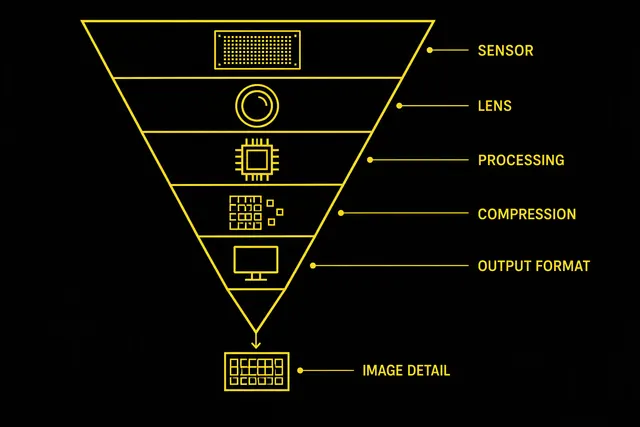
In camera development and image quality testing, it is only a starting point: the format describes the nominal pixel grid, but not how much detail a camera system actually reproduces. This overview compares the common formats from SD to 8K, explains the difference between UHD and DCI 4K and shows why effective resolution has to be measured.
At a glance
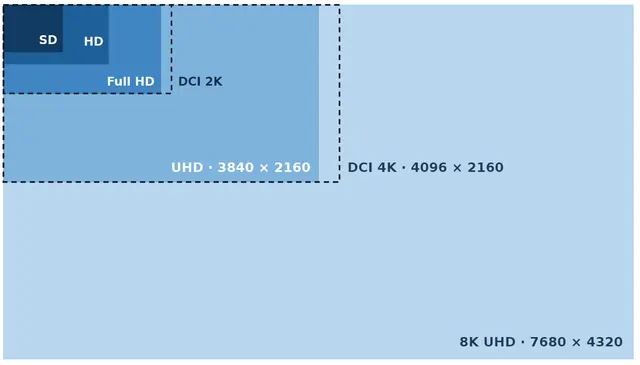
Video resolution formats compared
Nominal pixel dimensions. Megapixels rounded to two decimals.
| Format | Pixels | MP | Aspect ratio | Typical use |
|---|---|---|---|---|
| SD (PAL) | 720 × 576 | 0.41 | 4:3 (16:9 anamorphic) | Legacy broadcast |
| HD 720p | 1280 × 720 | 0.92 | 16:9 | Broadcast, web video |
| Full HD 1080p | 1920 × 1080 | 2.07 | 16:9 | Broadcast, consumer and automotive cameras |
| DCI 2K | 2048 × 1080 | 2.21 | approx. 1.9:1 | Digital cinema |
| UHD “4K” | 3840 × 2160 | 8.29 | 16:9 | TV, streaming, consumer cameras |
| DCI 4K | 4096 × 2160 | 8.85 | approx. 1.9:1 | Cinema production and projection |
| 8K UHD | 7680 × 4320 | 33.18 | 16:9 | Broadcast in Japan, high-end production |
Visual comparison of video formats
UHD vs. 4K: what is the difference?
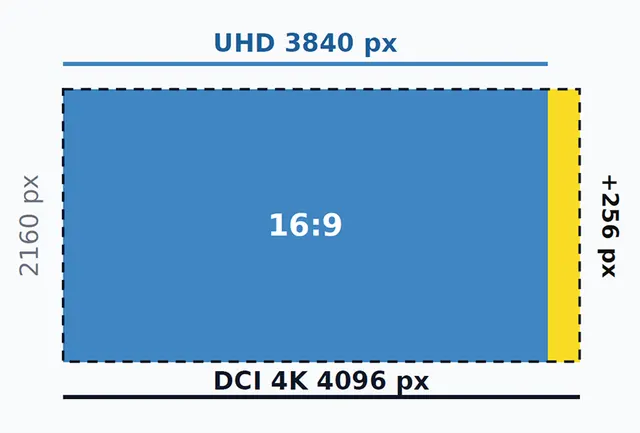
In consumer electronics, “4K” usually refers to UHD with 3840 × 2160 pixels, exactly four times Full HD in 16:9.
In digital cinema, 4K is defined by the DCI specification as 4096 × 2160 pixels, a slightly wider image.
For camera testing, the difference matters: chart framing, regions of interest and results in line widths per picture height (LW/PH) depend on the exact output format.
Why resolution format matters in camera testing
A higher pixel count does not automatically mean a sharper image. How much real detail ends up in the pixel grid depends on the entire imaging chain.
That is why image quality testing measures effective resolution, for example the spatial frequency response (SFR) with the methods of ISO 12233.
Frequently asked questions
Need help testing video cameras?
Related image quality topics
About this article:
Written by the Image Engineering test lab team. Technical review: Peter, Becker . Last updated: 2025 . Image Engineering is an independent test lab for camera image quality and develops test charts, analysis software and test equipment.