Geometric Calibration for Increasingly Complex Camera Systems
Wide fields of view, specialized lenses, and custom camera designs place growing demands on geometric characterization. With the latest version of the GEOCAL software, version 1.5, we expanded our software’s features with new analysis models, more flexible workflows, and additional automation capabilities that support users in demanding calibration tasks.
Geometric calibration is one of the fundamental steps in the development and characterization of modern camera systems. As the demands of imaging systems increase, the requirements for this task continue to grow in complexity. From ultra-wide-angle and fisheye lenses to custom optical designs, developers must accurately describe and evaluate an increasingly diverse range of camera distortion concepts.
To address these challenges reliably, flexible analysis tools are just as important as reproducible measurement methods. Not every camera system can be characterized using the same models or workflows. Depending on the application, different distortion models, specific analysis parameters, or automated evaluation procedures may be required.
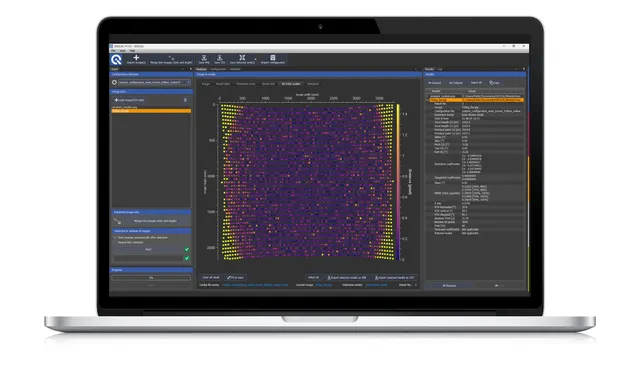
With the latest version of the GEOCAL’s software, version 1.5, we have expanded our software with features designed to make geometric calibration tasks more flexible and efficient. We’ve included new distortion models, such as the Rational Model and the OpenCV Rational Model, which support the analysis of a broader range of camera systems. A redesigned user interface conveniently simplifies the configuration and management of analysis parameters directly within the application.
The analysis workflow itself has also been streamlined. Grid point detection and subsequent analysis can now be combined into a single continuous process. For automated testing environments, a new command-line interface (CLI) enables recurring analyses to be efficiently integrated into existing development and validation workflows.
The update is complemented by additional capabilities, such as Field of View (FoV) calculations, grid point import and export, an integrated undistort function, and image processing of lens systems that require HDR processing to improve analysis (e.g. high vignetting)
The goal of these enhancements is not simply faster analysis. Rather, they provide developers with tools that can adapt to different camera systems and application requirements while delivering reproducible results. As modern imaging systems become increasingly complex, reliable geometric characterization becomes more important than ever.