Reliable Resolution Measurements Under High Image Noise Conditions
Resolution assessment is one of the most important methods for camera characterization. During its analysis, one question often arises: does a resolution measurement remain meaningful when the image is heavily affected by noise? High noise levels make it more difficult to evaluate the actual detail reproduction capabilities of a camera system. A recent study conducted as part of ISO standardization activities demonstrates that the Siemens-star MTF10 value continues to represent the visually perceived resolution limit reliably, even under these conditions.
Resolution measurement is one of the most widely used methods for evaluating camera systems. It serves as the basis for product comparisons, development decisions, and objective characterization of image quality. Under favorable lighting conditions, established measurement methods provide reliable and highly comparable results. But how meaningful do these measurements remain when image noise increases significantly?
This question was investigated within the activities of ISO TC42 Working Group 18. The study focused on whether the MTF10 value derived from a sinusoidal Siemens star according to ISO 12233 continues to reflect the resolution limit perceived by human observers at high visual noise levels.
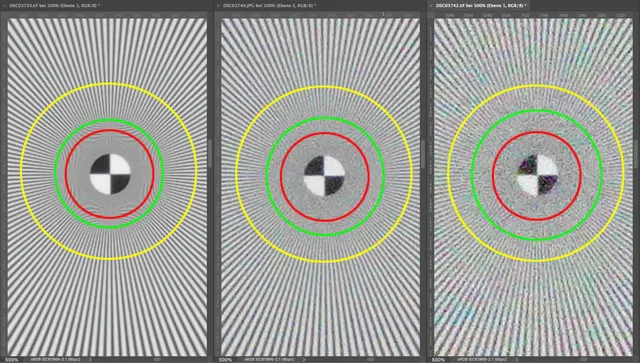
For the investigation, a TE42LL test chart according to ISO 19093 was captured using a Sony RX100 M6 at different ISO settings. To examine the effects of image noise as accurately as possible, the camera's internal noise reduction was largely disabled.
As expected, visual noise increased significantly with higher ISO settings. At the same time, the measured MTF10 value decreased. However, analysis of the Siemens star images showed that the measurement remained closely aligned with the actual visually perceived resolution limit. Even at high noise levels, the MTF10 value continued to indicate the point at which fine structures could no longer be resolved reliably by human observers.
This finding is particularly relevant for developers and test engineers. When evaluating cameras under challenging lighting conditions, measurement parameters are needed that provide reliable information even beyond ideal laboratory environments. The study confirms that Siemens-star MTF10 measurements remain a dependable indicator of visually perceived resolution, even when image noise is substantial.
The results demonstrate that established measurement methods can continue to provide meaningful information under demanding conditions, provided their interpretation is considered in the proper context. This highlights the value of objective image quality measurements: they create a reliable foundation for technical decision-making, even when measurement conditions are far from ideal.