Spectral sensitivity measurement with camSPECS
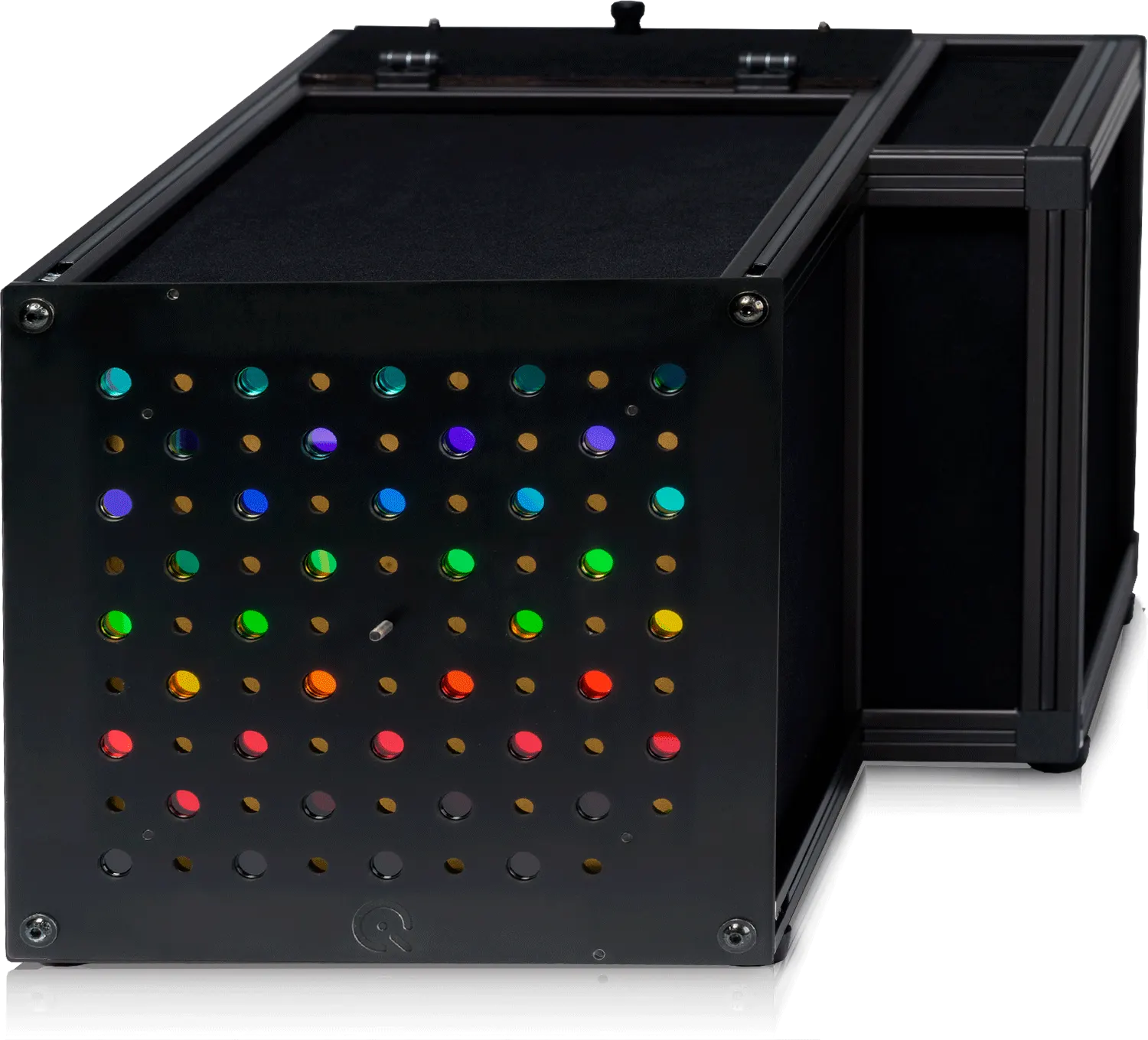
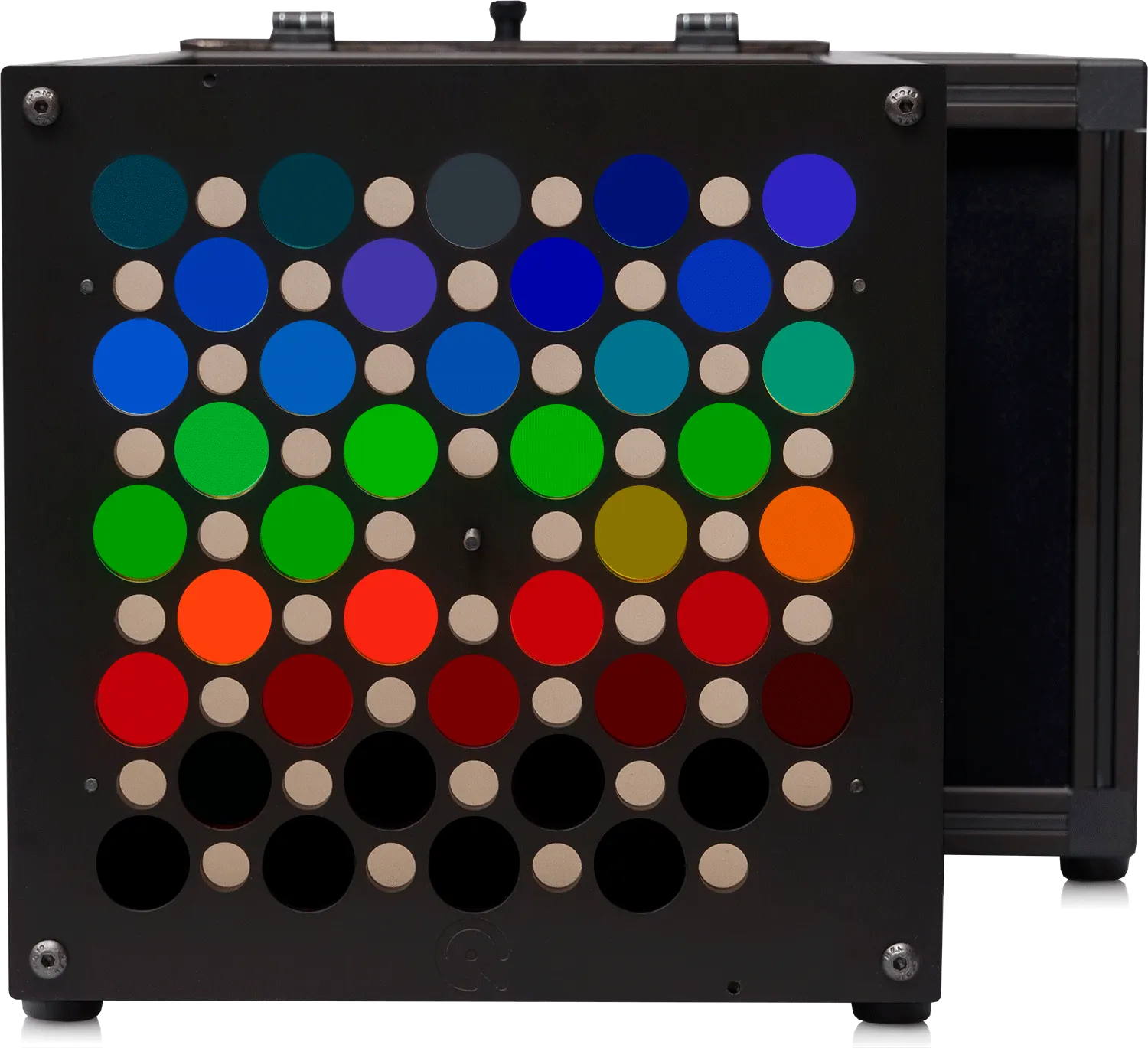
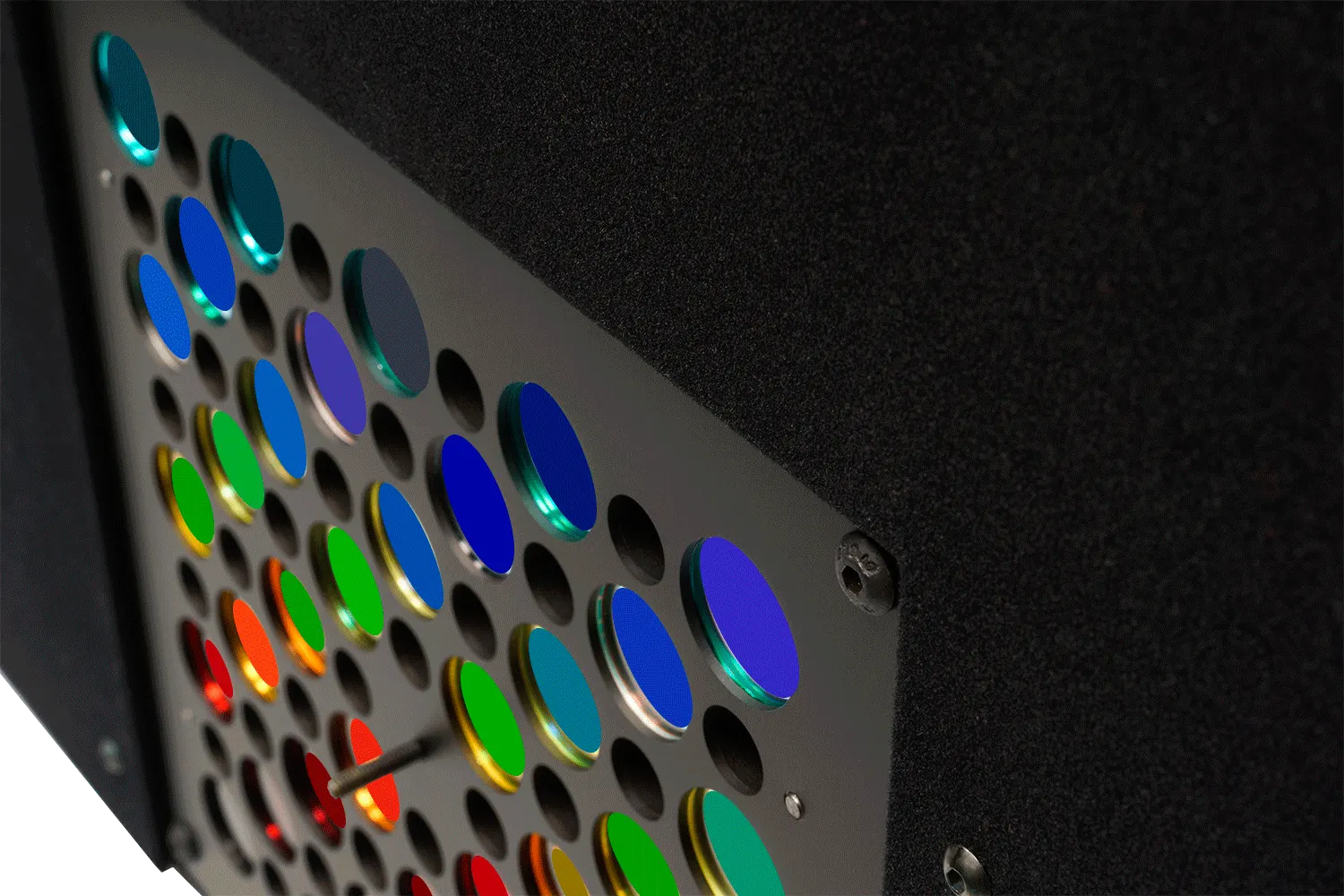
camSPECS enables spectral sensitivity measurement more effectively by mounting all interference filters on a single “test chart.” The newest version uses new high-quality interference filters. The light source is designed to ensure equal power output across the interference filters and not exceed the camera's dynamic range. Neutral-density filters on the front plate are used to compensate for potential illumination non-uniformities. The camSPECS hardware consists of a metal housing with a stabilized power supply for the halogen light source. The 39 interference filters, mounted on the front plate, provide monochromatic light from 380 nm to 760 nm.
camSPECS measures spectral sensitivity more effectively by mounting all interference filters on a single “test chart.” The newest version uses new high-quality interference filters.
The light source is designed to ensure equal power output across the interference filters and not exceed the camera's dynamic range. Neutral-density filters on the front plate are used to compensate for potential illumination non-uniformities.
The camSPECS hardware consists of a metal housing with a stabilized power supply for the halogen light source. The 39 interference filters, mounted on the front plate, provide monochromatic light from 380 nm to 760 nm.
Key Benefits
Measure spectral sensitivities
camSPECS is designed to enable more efficient spectral-sensitivity measurements for a camera system.
39 Interference filters
camSPECS combines all 39 high-quality interference filters onto one "test chart."
Determining CCMs
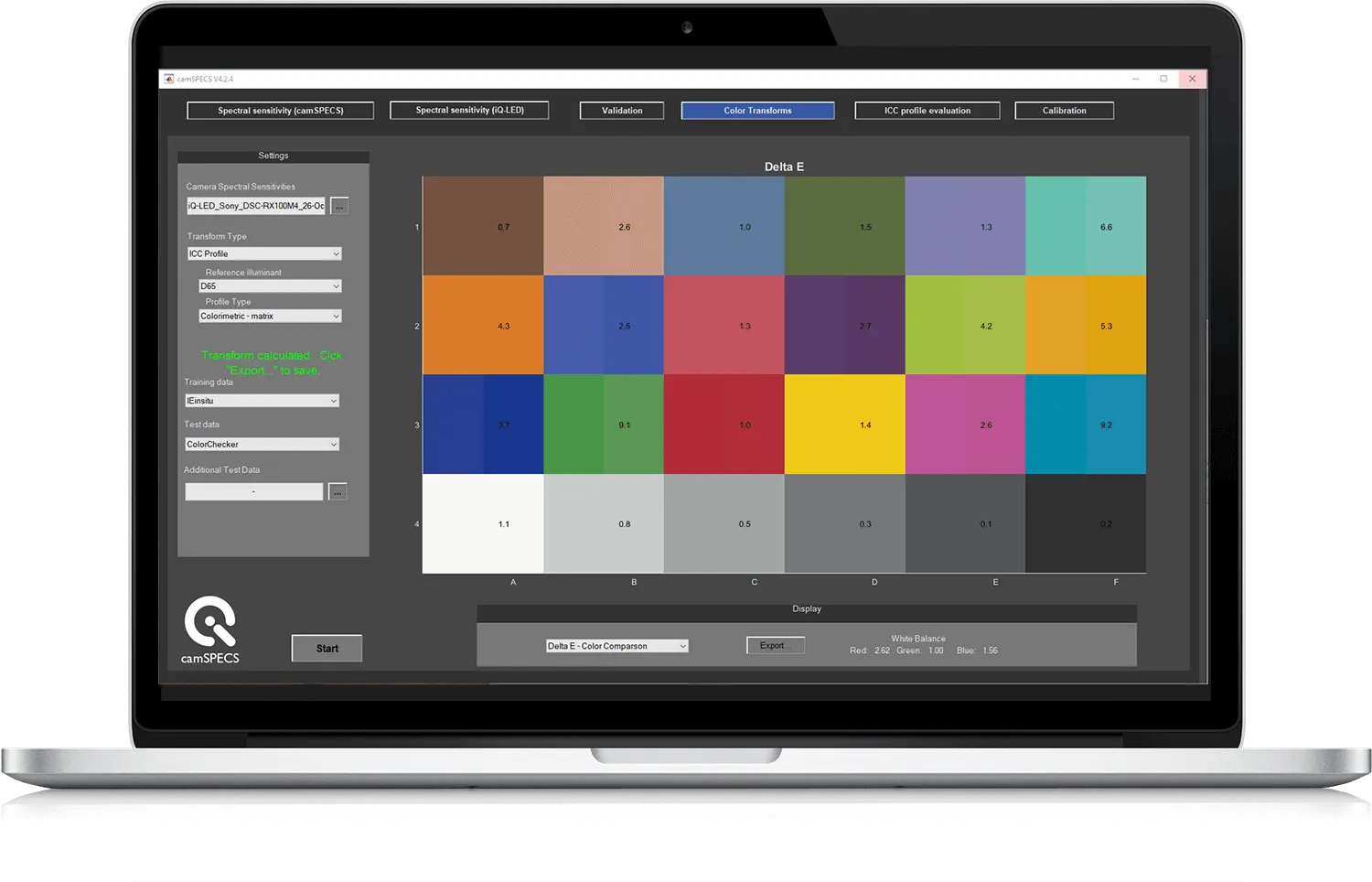
The camSPECS software has a module for calculating color correction matrices (CCMs).
Color transform generation
Use camSPECS to build optimal color transforms that convert camera values to colorimetric values.
Combine with in-situ database
Use our in-situ database to visually evaluate ICC profiles using real images.
Evaluation Software
Calculate the spectral sensitivity from the images and the filter calibration data as a direct measurement.
Product Options and Software
camSPECS XL & camSPECS Plate (iQ-LED)
The XL version uses the same new high-quality interference filters introduced in V2, but the filters now have twice the diameter. This larger version is better suited for measuring cameras with wide-angle lenses, such as those used in automotive camera systems.
camSPECS Plate (TE292)
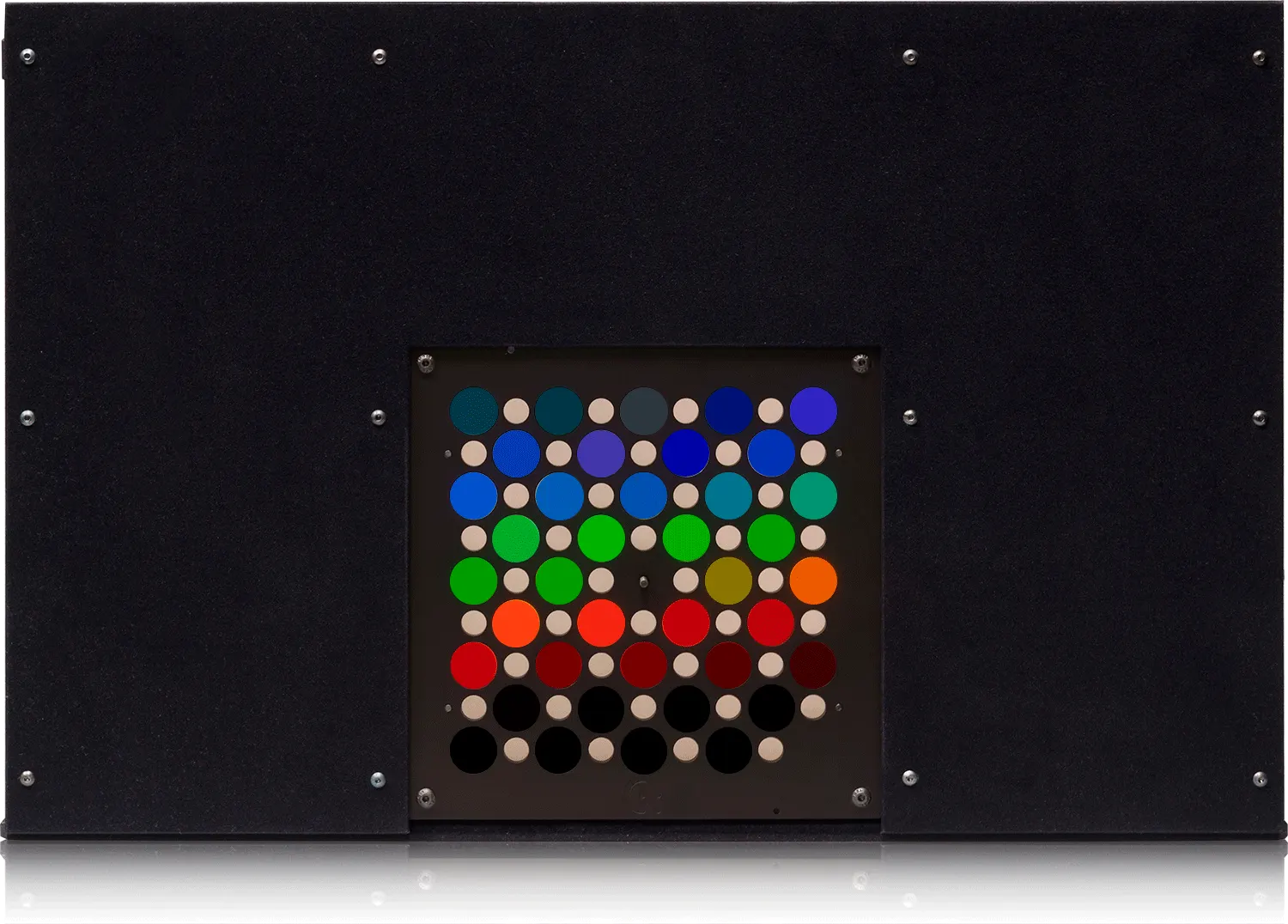
The plate is designed based on the front plate of the camSPECS device, with all interference filters mounted on a single “test chart” to quickly measure spectral sensitivities from a single image. Unlike the full camSPECS device, the camSPECS plate is a standalone product designed primarily for use with the LE7, a uniform iQ-LED illumination device.*
There are two versions of TE292: the standard version and the XL variant, known as TE292A and TE292 B, respectively. Both are designed to match the front plates of their respective camSPECS devices and include the camSPECS software. An external calibration device is available upon request if no LE7 is ordered simultaneously.
TE292B VIS-IR
This version of the camSPECS plate covers an extended wavelength range from 380 nm to 1050 nm in 10 nm steps and includes 68 filters.
camSPECS Software
The evaluation software makes measuring fast and convenient. It calculates spectral sensitivity from images and filter calibration data, providing a direct measurement (similar to a monochromator). The software reads image files such as TIFF or common raw files* and can perform a dark frame subtraction if needed. Non-Bayer pattern sensors (e.g., RGB-IR or RGBC) can also be evaluated. In this case, all four channels are measured independently.
The primary application of spectral sensitivities is to calculate color correction matrices (CCMs) using the CIECAM16 model and to export ICC and Adobe ACR profiles with 2D- and 3D-MLUT rendering. An additional feature assesses the measurement setup by comparing real camera data with predicted RGB values.
For calculating individual CCMs, the spectral radiance of natural objects from the in situ database may be used.
Software Features:
Spectral sensitivity measurement
Generation of color transforms, including 3x3 matrices and others (RGB to XYZ), with different algorithms supporting popular profile types
Creation of ICC profiles
Support for 2D- and 3D-MLUT color transforms
CIECAM16 implementation for building color transforms
A test procedure for evaluating color transforms with different training data
RAW file* processing / dark frame subtraction
Validation by comparing the camera and predicted RGB values
Visual evaluation of ICC profiles with real images
Calibration with an included calibration device
Export of all results to XML or plain text files
Use Cases
Determination of CCMs (color correction matrices)
The spectral sensitivity of a camera is interesting to examine, but the real benefit is using it to calculate the optimal color correction matrix for the camera. The camSPECS software includes a module for calculating such matrices. Three algorithms are implemented: a least-squares linear regression, a white-point-preserving least-squares regression, and the CIECAM16 model. The required input data are the camera spectral response, the illumination spectral distribution, and the spectral training data.
The required training data can be either the provided ColorChecker spectra or measured spectra of natural objects. Image Engineering provides access to a large database of in situ spectral radiance data. White balancing can be incorporated into the matrix calculation as a separate option.
Color Transform Generation
Once the camera spectral sensitivities are determined, it is possible to build optimal color transforms to convert camera values to colorimetric values. By including reference illumination and standard chart data (or newly available, specially measured in situ training data representative of real scenes), color transforms are built that optimize color appearance differences using CIECAM16. Various methods and transform types are supported, including colorimetric matrices, white-point-preserving transforms, and ICC profiles, with more being added continuously.
Technical Specifications
Detailed technical specifications and performance data
| camSPECS | camSPECS XL | |
|---|---|---|
| Light source | Halogen (24V / 250 W) Osram 64657 HLX | Halogen (24V / 250 W) Osram 64657 HLX |
| Color temperature | 3550 K | 3550 K |
| Wavelength range | 380 - 760 nm (10 nm steps) | 380 - 760 nm (10 nm steps) |
| Bandwidth | 10 nm | 10 nm |
| Diameter interference filters | 10 mm | 22 mm |
| Diameter ND filters | 6 mm | 10 mm |
| Dimensions [W x H x D] | 295 x 255 x 520 mm | 295 x 255 x 520 mm |
| Weight | 7 kg | 7 kg |
Software Downloads
Download the latest software package for camSPECS.
camSPECS Software
camSPECS Software changelog
Matlab Compiler Runtime R2016b (required)
Matlab MCR (Windows 64bit executable)
Documentation
camSPECS Datasheet
camSPECS XL Datasheet
camSPECS User Manual
Complete operating instructions
camSPECS Product Flyer
A basic product overview
Quickstart Guide
Terms & Conditions
Sample Data
camSPECS sample data (zip)