
A wide range of Test Services
Although we offer a wide range of standard image-quality tests, we understand that some companies and industries have unique testing requirements. As a result, we often work closely with our customers to determine their exact specifications and create a camera performance test accordingly. Over time, many companies began requesting the same or similar tests, and it became clear that offering our most-requested specialized camera tests as standard tests in our iQ-Lab would be beneficial.
Below is a list of a few unique tests we regularly provide:
Baseline Evaluation
Our iQ-Lab offers baseline evaluations for those looking to start a new camera development project. We will take your current system and provide baseline metrics on its current performance. From there, we can help you identify potential areas of improvement for the subsequent development project.
Conception and Proof of Concepts
In addition to offering baseline evaluations, we provide proof of concepts on potential development ideas, plans, or concepts. We will use your ideas to develop tests to assess how well the concept in question performs in practice. Thus, we can offer practical guidance before you delve deep into the development process.
Geometric Camera Calibration
Many industries that use wide-angle camera systems require special camera calibrations to ensure high-performance safety. None more so than the automotive industry, which uses various cameras and sensors for objective detection. These systems typically use wide-angle cameras that require geometric calibration to account for distortion. Our lab has extensive experience with geometric camera calibrations using the GEOCAL device.
Iterative Development Validation Tests
We have also worked with many companies to help them validate each iteration of their development process. These validation tests have helped companies determine whether their development path follows their performance requirements.
Luminance Calibration
Did you know that you can use the iQ-Luminance software to turn your camera into a luminance meter? With proper calibration, your camera offers several advantages over conventional luminance meters. To utilize the luminance software, you must first send the camera to our iQ-Lab for proper camera calibration.
Pressurized Testing
Our lab contains a specialized pressure box that allows us to control the pressure level experienced by the device under test (DUT). We take photos of a TE 42 chart both before and after the camera has dried off on the test stand, in order to identify any differences. Volume: 42 liters; max. pressure: 2.5 bar.
Sample-to-Sample Deviation
We often work with companies to ensure their sample-to-sample deviations do not exceed defined performance thresholds. For example, we can conduct performance tests against established standards to determine whether a new or modified camera module deviates significantly from defined performance thresholds.
Spectral Sensitivity and Color Calibration
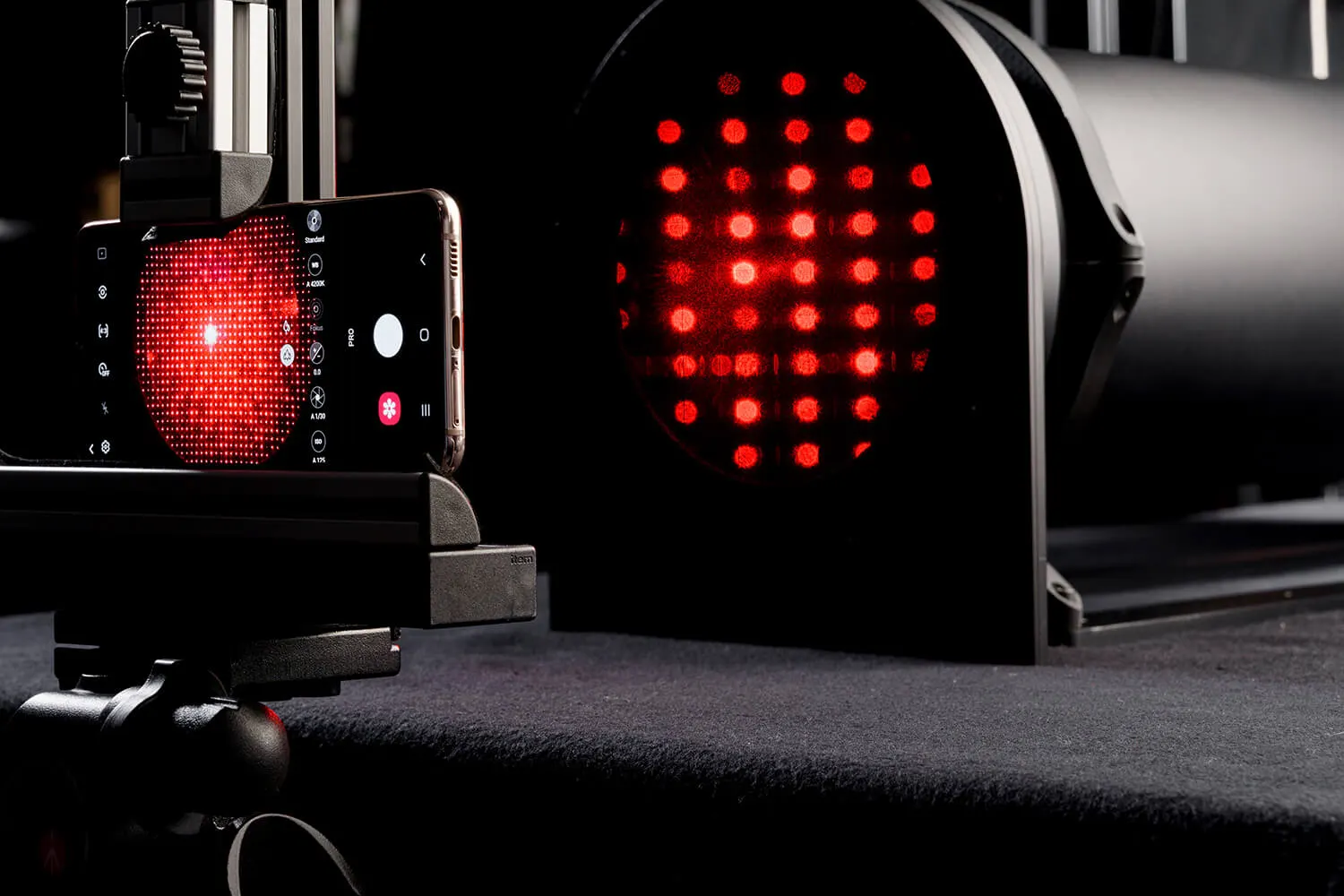
Camera color characterization is an essential step in the color image processing pipeline. Our iQ-Lab uses advanced camera test equipment, such as camSPECS, to enable more efficient spectral sensitivity measurements and camera color calibration. These color tests have become crucial when determining a camera system's color reproduction accuracy.
Temperature-Controlled Testing
One of our most requested test procedures is to perform specific standard performance tests at varying temperature levels. Using the iQ-Climate Chamber, we can offer temperature-controlled testing of most standard performance tests in a lab environment. Temperature-controlled testing is essential for the automotive and security industries, where camera systems must perform reliably in diverse weather conditions.
Underwater Testing
Our test lab houses a 450-liter water tank equipped with test targets, enabling us to conduct image quality tests with an underwater camera.