Newsletter July 2026: Relaunch of our website – what’s new!
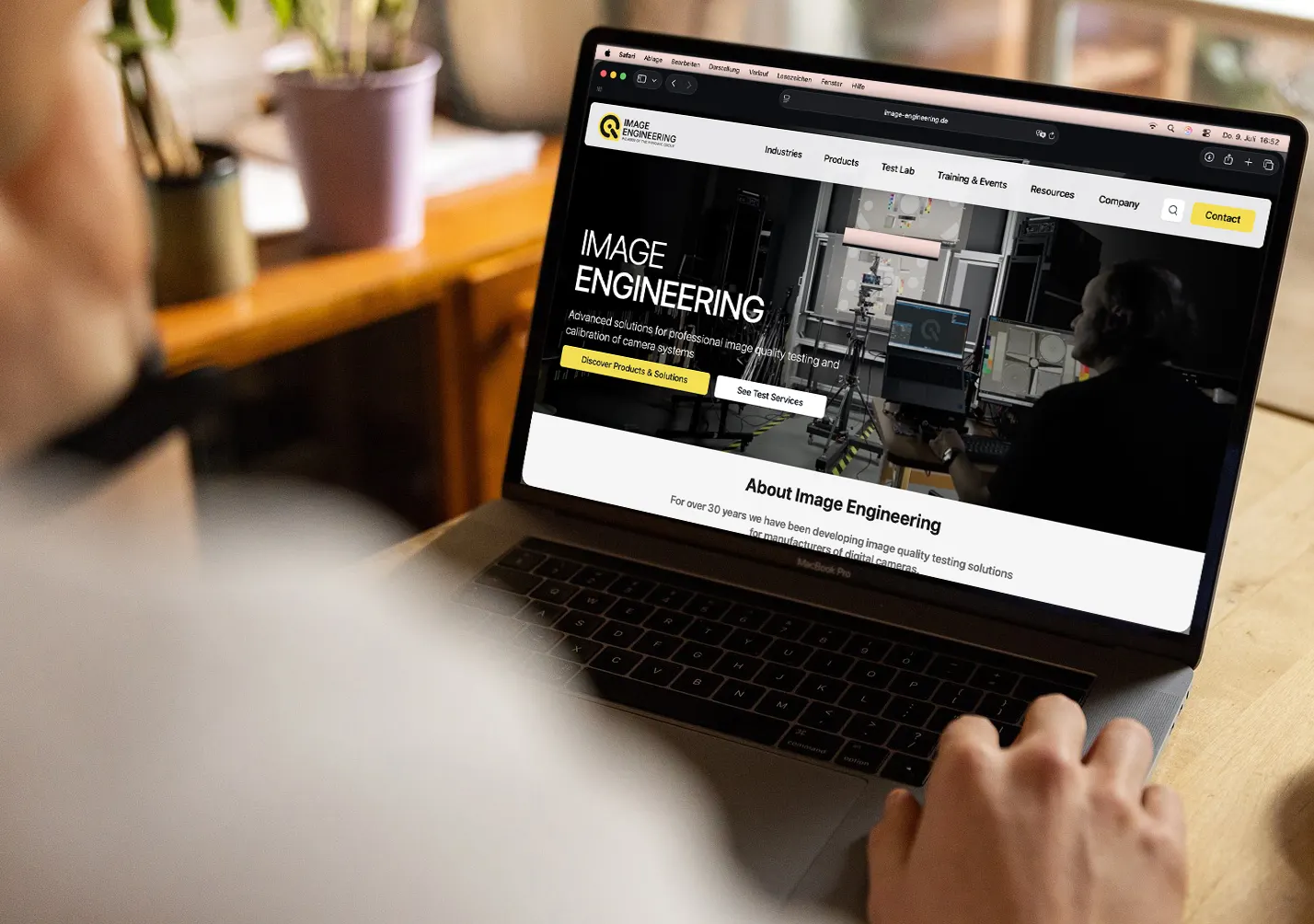
31 years of Image Engineering – a good reason to treat ourselves (and you) to a comprehensive website relaunch. Our goal was not only a fresher look, but also more value for you as users. Below is a summary of what’s new …
Jump straight in by industry and camera application
Contrast, color, resolution … different industries prioritize different aspects of “image quality”. Thanks to the new site structure, you can now navigate more precisely via industries, applications, and typical image‑quality requirements to get to what matters to you.
#Automotive, #Surveillance, #Mobile Phone, #Webcam, #Machine Vision, #Medical & Endoscopy, #Photo & Video, #Digitization & Archiving, #Drone – for virtually every industry working with imaging systems, Image Engineering provides fitting solutions for image‑quality testing. The new website uses the industry perspective to get you quickly to the right information:
• Key applications – applications and their related image‑quality factors
• Important international standards – defining the industry benchmarks for testing and evaluation
• Key products – state‑of‑the‑art test solutions for each field
• Relevant services – tailored test methods in our lab
• Practical best‑practice examples – complete test setups for quality assurance
Conclusion:
Industry‑specific, practice‑oriented information – our new website improves the hit rate for R&D. If you want to go deeper or have detailed questions about standards, measurement methods, or integration limits, you can contact our experts directly from the respective industry page.
iQ‑Lab at a glance: How we make image quality measurable and comparable
Image quality is not a matter of opinion. As an independent test lab that applies carefully proven, well‑documented methods according to international standards and guarantees reproducible results, we provide a solid basis for your technical decisions. Explore the iQ‑Lab online.
Our iQ‑Lab offers professional solutions for precise testing and calibration of camera systems. Through valid test scenarios and data, our experts create an objective basis for assessment that development, procurement, and quality assurance can all rely on. Our lab supports your development cycles in three steps:
In characterization, we evaluate the properties and performance of the complete imaging system, the optic integrated with its capture device, quantifying parameters such as resolution, noise behavior, dynamic range, color accuracy, spectral response, and geometric distortion.
In qualification, we verify whether specified requirements, thresholds and tolerances are met under the intended operating conditions, including sample‑to‑sample consistency.
In validation, we ensure independent proof of performance ahead of key milestones and before market launch. Depending on the application, we validate according to recognized industry standards. Examples include IEEE‑2020 in automotive, VCX in smartphones, or EMVA 1288 for machine‑vision systems. Which standard makes sense in a given case is something we clarify with you in the project context. Many industries have specific test requirements, so we also develop individual tests with you.
iQ‑Lab test reports deliver real value. Standardized procedures establish a common technical language between engineering and management – and between you and your suppliers. Risks become visible earlier, comparisons are more objective, and approvals gain speed. Products are more likely to reliably meet the required performance.
Conclusion:
If you haven’t seen our lab in action yet, you can now get a solid first impression online – including topic‑based entry points by application and question.
Visit the Lab
Knowledge base “Image quality”: From overview to deep dive
Our extensive knowledge base supports developers and image quality experts in evaluating and specifying camera systems. As part of our website relaunch, we have re‑organized and re‑edited the collected material on the key factors of image quality.
Which factors determine perceived image quality? How can these factors be represented in a robust and comparable way? Which boundary conditions – e.g., illumination or temperature – must be in place to make measurements truly meaningful?
The “Understanding Image Quality” page offers a compact introduction to all central factors of image quality – from resolution, dynamic range, and noise to color accuracy, distortion, texture loss, low‑light behavior, or image stabilization.
There are currently 16 parameters, each covered individually with a precise definition, guidance for different applications, and an explanation of common camera tests, measurement methods, and international standards. It quickly becomes clear where performance limits lie and which levers allow for improvement – whether in the sensor, the optics, or the signal‑processing chain.
With minimal research effort, you’ll find a reliable technical foundation to build a deeper understanding of the subject and the terminology. Depending on your question, you can use the content which ranges from the basics to detailed technical information: you are guided to in‑depth documentation, videos, white papers, and conference contributions.
Conclusion:
Our knowledge pages bring together the fundamentals and measurement logic of image quality in one place – clear, structured, and practice‑oriented for development and quality assurance.
Start reading now