
Overview
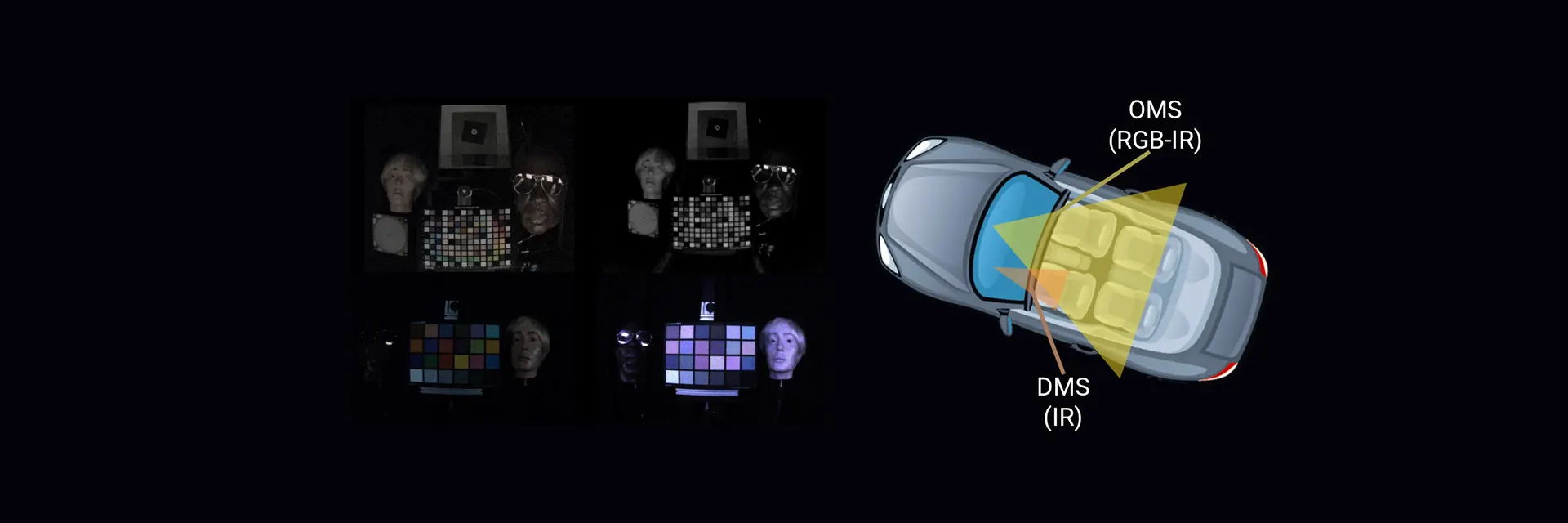
Image Quality Testing & Solutions for In-Cabin Monitoring Systems | As the automotive industry advances toward full automation, in-cabin monitoring systems, commonly known as driver and occupant monitoring systems (DMS/OMS), have become a key area of focus. Using cameras and sensors, these systems monitor the vehicle interior and the driver's response to the driving environment, improving both safety and comfort. By tracking driver alertness, they help reduce human-error accidents, for example, slowing the car when drowsiness is detected. The importance of this technology is reflected in the European Union's General Safety Regulation (GSR), which mandates DMS in all new cars from 2024. As these systems become indispensable to road safety, manufacturers need reliable calibration and characterization solutions throughout development to guarantee the highest image quality and safety performance. In-cabin systems capture video and images to assess occupant behavior and facial cues. They rely mainly on near-infrared (NIR) sensors with active illumination (e.g., LED or VCSEL, typically around 850 nm or 940 nm), ensuring accuracy in very low light without a visible source that would distract occupants. The captured data feeds into embedded machine vision software for tasks such as detecting drowsiness, gaze, hand position, seatbelt usage, child seats, and occupant posture for optimized airbag deployment. When the vehicle drives autonomously, these systems can also support human-vision applications such as video calls or selfies. Increasingly, a single sensor combines RGB and IR functionality on one chip, an elegant solution that introduces new characterization challenges, making thorough testing under realistic conditions more important than ever.
As the automotive industry advances toward full automation, in-cabin monitoring systems, commonly known as driver and occupant monitoring systems (DMS/OMS), have become a key area of focus. Using cameras and sensors, these systems monitor the vehicle interior and the driver's response to the driving environment, improving both safety and comfort. By tracking driver alertness, they help reduce human-error accidents, for example, slowing the car when drowsiness is detected.
The importance of this technology is reflected in the European Union's General Safety Regulation (GSR), which mandates DMS in all new cars from 2024. As these systems become indispensable to road safety, manufacturers need reliable calibration and characterization solutions throughout development to guarantee the highest image quality and safety performance.
In-cabin systems capture video and images to assess occupant behavior and facial cues. They rely mainly on near-infrared (NIR) sensors with active illumination (e.g., LED or VCSEL, typically around 850 nm or 940 nm), ensuring accuracy in very low light without a visible source that would distract occupants. The captured data feeds into embedded machine vision software for tasks such as detecting drowsiness, gaze, hand position, seatbelt usage, child seats, and occupant posture for optimized airbag deployment.
When the vehicle drives autonomously, these systems can also support human-vision applications such as video calls or selfies. Increasingly, a single sensor combines RGB and IR functionality on one chip, an elegant solution that introduces new characterization challenges, making thorough testing under realistic conditions more important than ever.
Why RGB-IR is hard to get right
One sensor, two jobs
RGB-IR sensors pack a dedicated infrared pixel right alongside red, green, and blue in the same color filter array, letting one camera deliver a clean color image by day and a usable IR image by night. That convenience comes with real image quality risk: infrared leakage into the visible channels, color contamination, and demosaicing artifacts that only show up under the right test conditions.
Verifying that a single device performs across the full visible-to-NIR range, and at every occupant position the camera is meant to cover, calls for measurement methods and test equipment that span the same spectrum as the application itself. That is exactly what our iQ-Lab is built to do.
RGB-IR Test Service
Let the iQ-Lab characterize your system
Our iQ-Lab delivers independent, standard-driven characterization of in-cabin and RGB-IR cameras across the full visible-to-NIR range, so your team gets reliable, reproducible image quality data without building and maintaining a NIR-capable test setup of its own.
One report, both channels - A single measurement program covering the RGB and the IR behavior of your sensor, side by side.
Application-realistic conditions - Mixed lighting, high-contrast scenes, and NIR illumination matched to your real use case.
Development-ready results - Objective KPIs and documentation your engineering team can act on right away.
What we measure in In-Cabin Testing
The measurement scope behind a reliable in-cabin and RGB-IR camera characterization at the iQ-Lab
Resolution (SFR)
Distortion & Geometric Calibration
Dynamic Range, OECF & SNR
Color Accuracy
Color fidelity is especially critical for RGB-IR sensors in mixed-lighting situations, or under sunlight carrying a strong IR component that can contaminate the visible channels. We evaluate color accuracy across the relevant illuminants to keep the daytime color image clean.
International Standards relevant to In-Cabin Imaging
IEEE-2020:2024
ISO 12233
ISO 14524 / ISO 15739
ISO 14524 defines OECF measurement, the basis for tonal response, dynamic range, and contrast, while ISO 15739 covers noise and signal-to-noise ratio across light levels, together describing how the camera renders high-contrast cabin scenes.
Prefer to Test In-House?
Already running a camera testlab? Our VIS-IR product line covers the same visible-to-NIR range, so you can perform these measurements yourself.
Flatlight VIS-IR
LE7 VIS-IR
VEGA IR
Analysis Software
Automated, objective evaluation of SFR, distortion, OECF, SNR, and color accuracy from a single capture, turning chart images into reproducible KPIs for both RGB and IR channels.