
Overview
Medical Image Quality Testing Services | Cameras have become a core component of modern medical devices. Endoscopes guide minimally invasive procedures, surgical microscopes and operating cameras support the surgeon, and digital pathology scanners turn glass slides into images that pathologists diagnose from. In each case, what the physician sees on the display is the result of a complete imaging chain and the quality of that image can directly affect a diagnosis or the outcome of a procedure. For this reason, image quality in medical imaging is not a cosmetic property but a performance characteristic. Resolution, contrast, color fidelity, noise, dynamic range, distortion, and field of view all determine how reliably a device represents the tissue or structure it is pointed at. Regulatory pathways — the FDA 510(k), De Novo, and PMA processes in the United States, or the EU Medical Device Regulation (MDR) in Europe — require that imaging performance is characterized and documented, but they generally do not prescribe how each optical attribute should be measured. That is where the iQ-Lab comes in: objective, reproducible measurements, traceable to recognized methods and standards.
Cameras have become a core component of modern medical devices. Endoscopes guide minimally invasive procedures, surgical microscopes and operating cameras support the surgeon, and digital pathology scanners turn glass slides into images that pathologists diagnose from. In each case, what the physician sees on the display is the result of a complete imaging chain and the quality of that image can directly affect a diagnosis or the outcome of a procedure.
For this reason, image quality in medical imaging is not a cosmetic property but a performance characteristic. Resolution, contrast, color fidelity, noise, dynamic range, distortion, and field of view all determine how reliably a device represents the tissue or structure it is pointed at.
Regulatory pathways — the FDA 510(k), De Novo, and PMA processes in the United States, or the EU Medical Device Regulation (MDR) in Europe — require that imaging performance is characterized and documented, but they generally do not prescribe how each optical attribute should be measured. That is where the iQ-Lab comes in: objective, reproducible measurements, traceable to recognized methods and standards.
Let the iQ-Lab characterize your imaging device
Our iQ-Lab is one of the world's largest independent camera test labs. We characterize the optical image quality of endoscopes, surgical cameras, and digital pathology systems under controlled, reproducible conditions — using methods aligned with the ISO 8600 series and the photographic image quality standards that medical imaging has adopted.
Most of our work in this field supports the preliminary investigations that precede formal qualification. In several projects, our measurement data has gone further and fed directly into our clients' qualification and change-approval documentation — because results that are objective, reproducible, and traceable can stand as evidence within a manufacturer's own submission.
What we Test
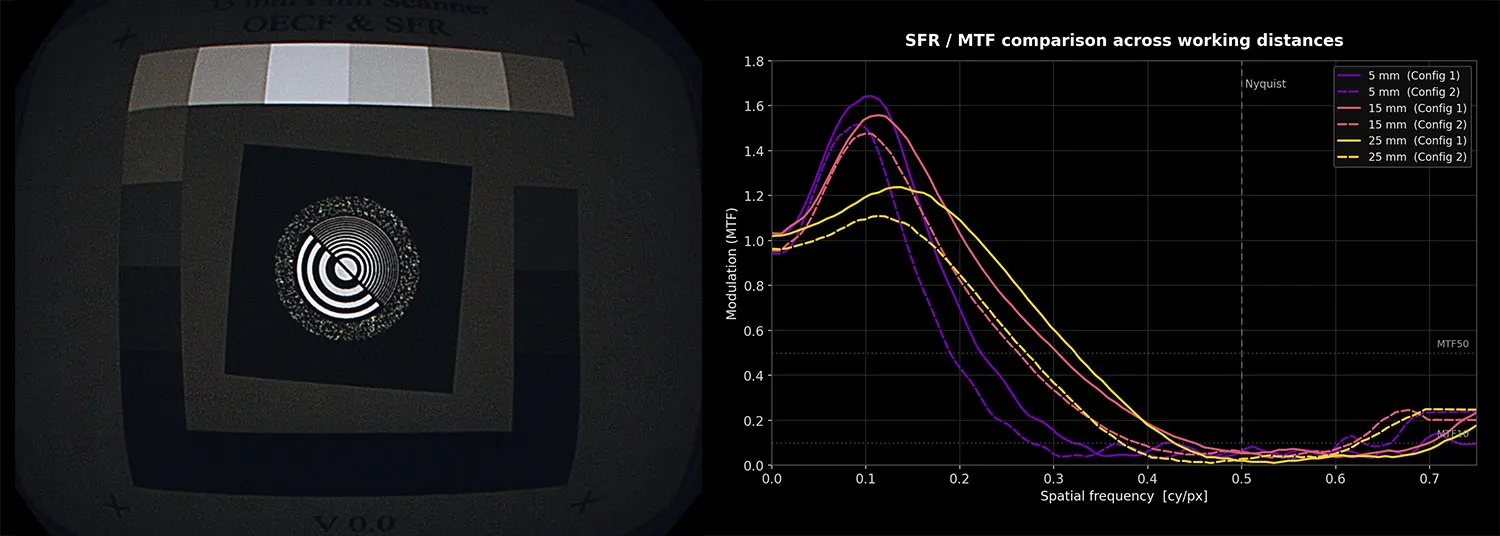
Resolution & Sharpness (SFR)
Dynamic Range & OECF
Noise & SNR
Color & White Balance
Field of View & Distortion
Light Leakage & Stray Light
Verification that the imaging system does not introduce unwanted light or veiling glare that would obscure the scene under clinical conditions.
Relevant Standards & Frameworks
The standards our methods follow, and the frameworks that govern market access
ISO 8600 Series
ISO 12233 / 15739 / 14524
FDA (United States)
Medical imaging devices reach the US market through the FDA 510(k), De Novo, or PMA pathways, which require documented imaging performance. FDA guidance on digital pathology (WSI) devices makes color performance a required system test.
EU MDR (Europe)
The Medical Device Regulation (EU) 2017/745 governs market access, with conformity assessed by notified bodies for CE marking. It requires that a device's performance — including imaging performance — is characterised and documented.
Prefer to Test In-House?
If you run your own lab, we supply the same charts, light sources, and software the iQ-Lab uses.
iQ-Analyzer-X
camSPECS & TE Color Charts
Spectral camera characterization and reference color charts for precise, repeatable color measurement — central to digital pathology and endoscopy.
iQ-LED & LE7
LED light sources that reproduce custom spectra with high uniformity, so a device can be tested under illumination matched to its intended use.